Machine Screw Jack vs. Ball Screw Jack: How to Make the Call
October 19th, 2026
3 min read
By Bryan Sample
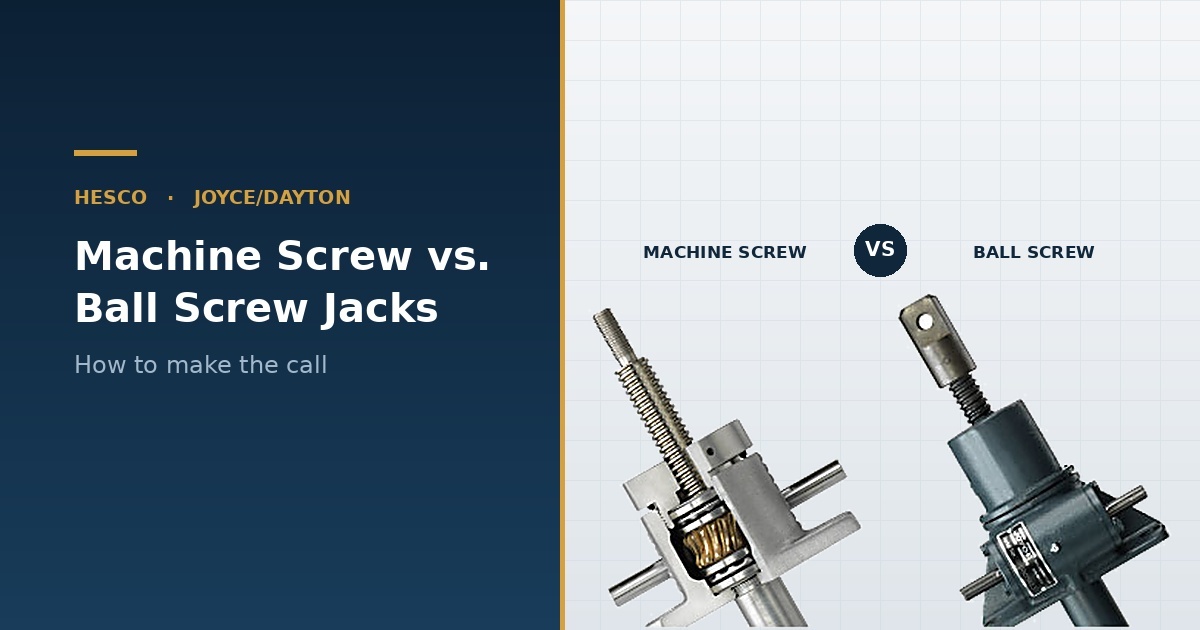
Most screw jack selections come down to the same fork, and it usually gets settled by whichever jack the last machine used. That works until the duty cycle changes, the motor budget tightens, or somebody asks what happens when the power drops.
The comparison isn’t close on efficiency, and it isn’t close on load holding either — and those two facts point in opposite directions, which is why both families are still in the Joyce/Dayton catalog. At HESCO we spec these into conveyor, packaging, material handling, steel, and process applications. Here’s how we actually work the decision with customers.
The short version: a ball screw jack cuts input torque by half to two-thirds and more than doubles efficiency, but it backdrives under load and requires a brake. A single lead machine screw jack holds position with no power, scales to 250 tons against the ball screw’s 50-ton ceiling, and offers keyed non-rotation as a stock option.
The Head-to-Head, With the Geometry Held Constant
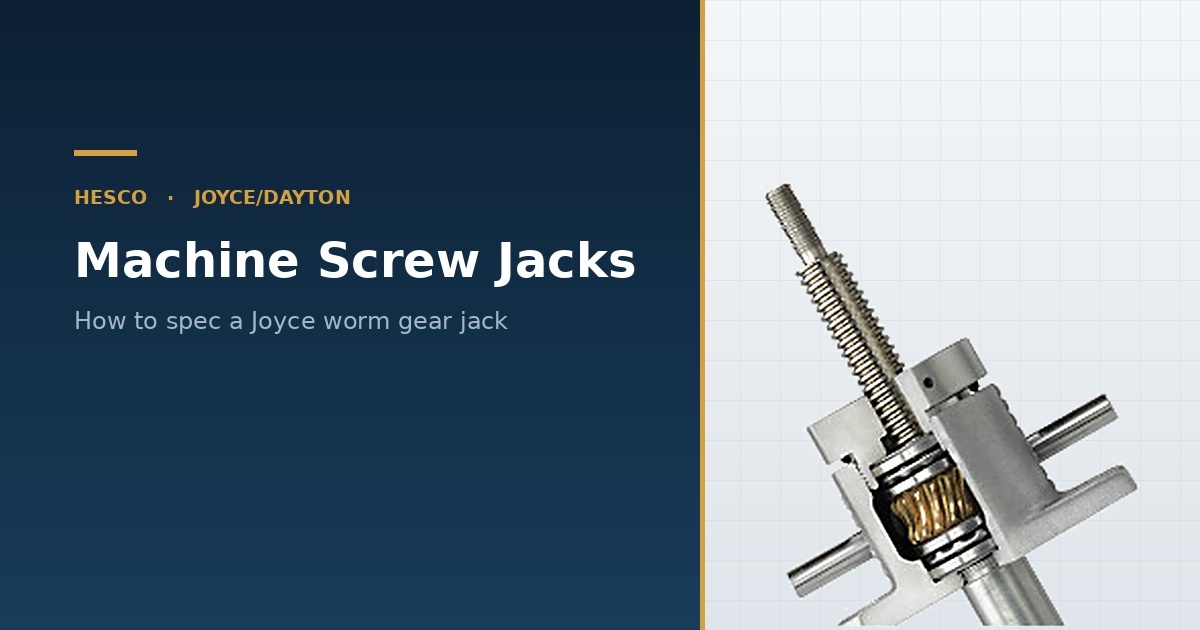
Efficiency comparisons across families are usually apples to oranges, because lead, ratio, and screw diameter all move at once. Joyce/Dayton’s 10-ton models avoid that: the WJ810 and heavy duty WB810 share a 2-inch screw, .500 lead, 8:1 ratio, and 16 worm shaft turns per inch. The only real difference is the nut.
| 10 ton, 2" screw, .500 lead, 8:1 ratio | WJ810 — machine screw | WB810 — ball screw |
|---|---|---|
| Efficiency rating | 23.1% | 50.7% |
| Starting torque | 0.061 × load | 0.023 × load |
| Operating torque @ 200 RPM | 0.043 × load | 0.019 × load |
| Worm shaft turns per 1" of travel | 16 | 16 |
| Self-locking | Yes | No — brake required |
| Backlash control | Anti-backlash, field adjustable | Oversized ball bearings, 0.003" |
| Published life figure | None — wear managed by adjustment | 729,000 in. at rated load |
Torque figures are coefficients: multiply by the load in pounds, then add 20 in-lb tare. Source: Joyce/Dayton published specifications.
At the full 20,000 lb rating that’s 1,240 in-lb of starting torque for the machine screw jack against 480 in-lb for the ball screw — a difference that compounds through every coupling, line shaft, and reducer on a multi-jack system. The efficiency argument gets stronger as the system gets bigger.
Note the row that doesn’t move: travel per input revolution is identical. A ball screw jack is only "faster" when the lead changes too.
Load Holding Ends the Debate
If the load must sit at position without moving, a single lead machine screw jack besides the WJ500 does it mechanically. Nothing else in either family does: double lead DWJ and DRWJ jacks are not self-locking, and no ball screw jack is self-locking in any configuration. Joyce/Dayton requires brake motors or external locking systems on ball screw jacks and advises against hand wheels entirely.
For brake sizing, the ball screw tables publish worm holding torque — 180 in-lb on a WB810 at 20,000 lb, 1,300 in-lb on a 50-ton WB1150. Size with margin, and use a fail-safe brake if a power loss must not become a motion event.
One corollary catches people. If you’re reaching for a double lead machine screw jack to get travel speed, you’ve given up self-locking and need a brake anyway — carrying the efficiency penalty for nothing. Double lead still wins on cost, on capacity above 50 tons, or with an existing installed base. But "I need more speed" alone isn’t reason enough.
Duty Cycle and Heat
This is the failure mode we see most, and it rarely shows up as a jack failure — it shows up as a nut replacement interval that keeps shortening. At 10–25% efficiency, most of the input energy ends up as heat between the machine screw and the bronze nut. Ball screw jacks are far more efficient, though Joyce/Dayton notes their cycles still need some rest. Neither is rated for continuous duty.
The practical test: if the jack moves most of the time, or hunts continuously against a process variable, the machine screw jack is your constraint and the ball screw buys real headroom. If it moves a few times a shift and then holds, the thermal disadvantage never materializes and the load holding is free.
Making the Call
Run the requirements in this order and most selections settle before you reach the bottom.
- Load above 50 tons? Machine screw jack — ball screw jacks stop at 50 tons. No decision to make.
- Must the load hold with no power and no brake? Single lead machine screw jack (except for WJ500). This is the one thing a ball screw cannot do at any price.
- Does the screw need internal rotation restraint? Machine screw jack, keyed design, WJ500 and larger. Ball screw jacks can’t be keyed the same way and it isn’t a standard option.
- Heavy duty cycle, or heat already a known problem? Ball screw jack — this is where efficiency converts directly into service life.
- Motor, reducer, or line shaft size constraining the design? Ball screw jack. Roughly half the input torque compounds across the whole drivetrain.
- Nothing above binding? Cost, standardization, and spare parts commonality are legitimate tiebreakers. A plant that already stocks one family has a real reason to keep stocking it.
One myth worth killing on the way out: ball screw jacks publish a probabilistic ball nut life to check accumulated travel against, while machine screw jacks publish none because you monitor backlash and adjust for wear instead. Assuming a ball screw is "maintenance free" because it has no adjustment procedure is exactly backwards.
The Bottom Line
This decision is usually settled by a requirement, not a spec sheet. Load holding, capacity above 50 tons, and keyed non-rotation point one way; duty cycle, heat, and drivetrain size point the other. The efficiency numbers are real — but they’re the tiebreaker in a smaller share of applications than most selection guides imply.
Want help running the comparison against your actual load, rise, duty cycle, and controls? The HESCO team can work the numbers both ways and help you land on a configuration you can defend at design review. Get in touch and let’s work through it together.
Topics: