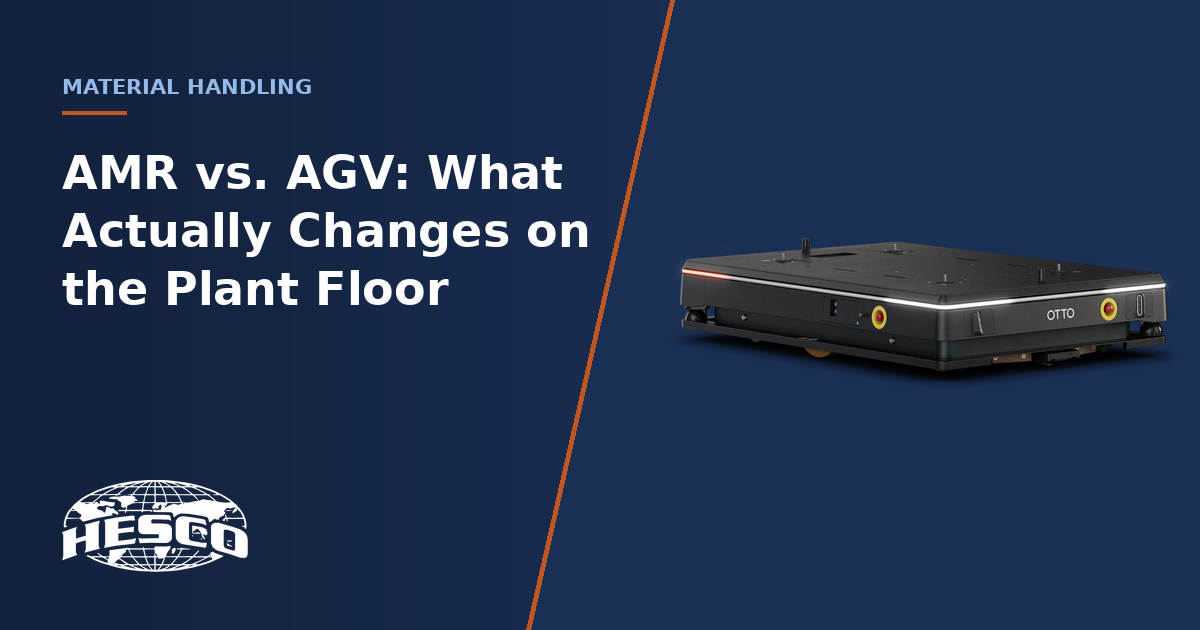
If you've specified guarding for a robot cell, you know the drill: R15.06, a risk assessment, a defined safeguarded space, and a fence. Mobile robots break that model. There is no cell, the hazard moves, and the safeguarded space is the whole plant floor.
The short version: since 2020 there's been a dedicated US standard for mobile robots, ANSI/RIA R15.08. It splits responsibility across three parts — the robot builder, the integrator, and you. Buying a compliant robot satisfies one of the three; the other two are where most of the work sits.
R15.08: the standard that changed the conversation
Before 2020, mobile robots were assessed under ANSI/ITSDF B56.5, released in 1978 for automated guided vehicles. With its AGV roots, B56.5 focused on stopping the vehicle if it deviated from its path or met an obstacle — which works when the path is fixed, and leaves a gap for AMRs that don't follow a defined path at all.
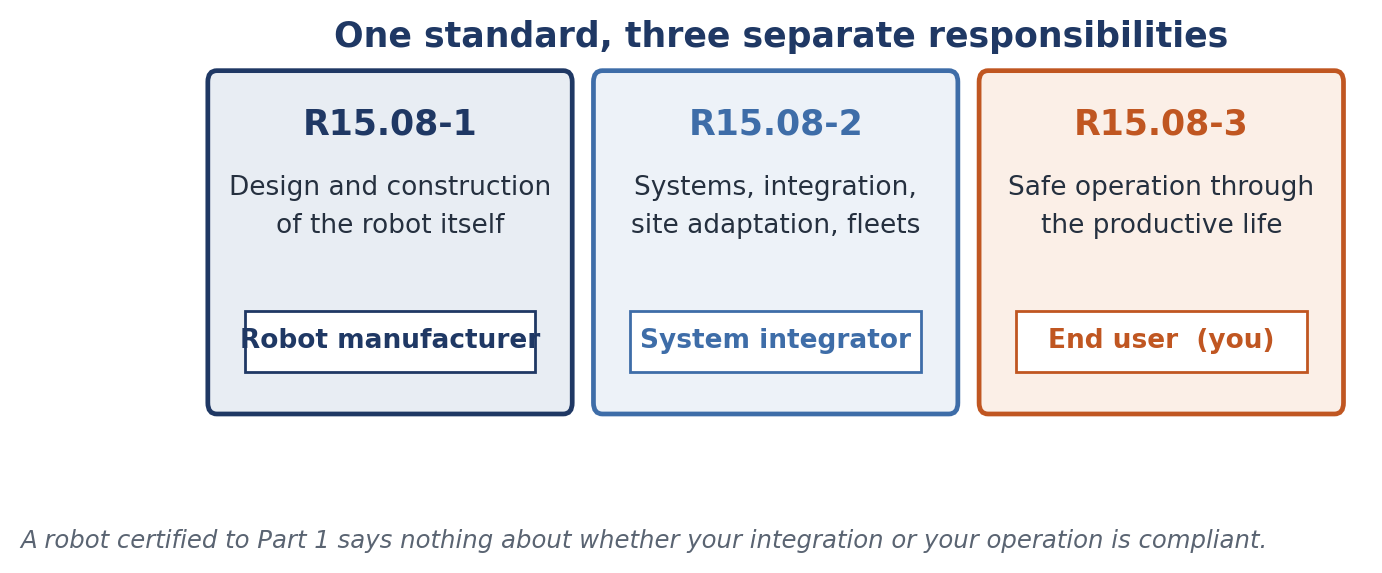
ANSI/RIA R15.08-1-2020 closed that gap as the first US national safety standard written specifically for industrial mobile robots. It's published in three parts, each aimed at a different party:
R15.08 doesn't stand alone. A US deployment typically also touches ANSI/ITSDF B56.5, ISO 3691-4, ISO 12100 (risk assessment methodology), ISO 13849-1 (performance levels), and EN 1175-1 / IEC 60204-1 (electrical).
The part worth internalizing: a vendor telling you their robot conforms to R15.08-1 is telling you about Part 1. It says the machine was designed to the standard. It says nothing about whether your deployment is compliant, because integration lives in Part 2 and ongoing use lives in Part 3.
IMR types: why attachments change your obligations
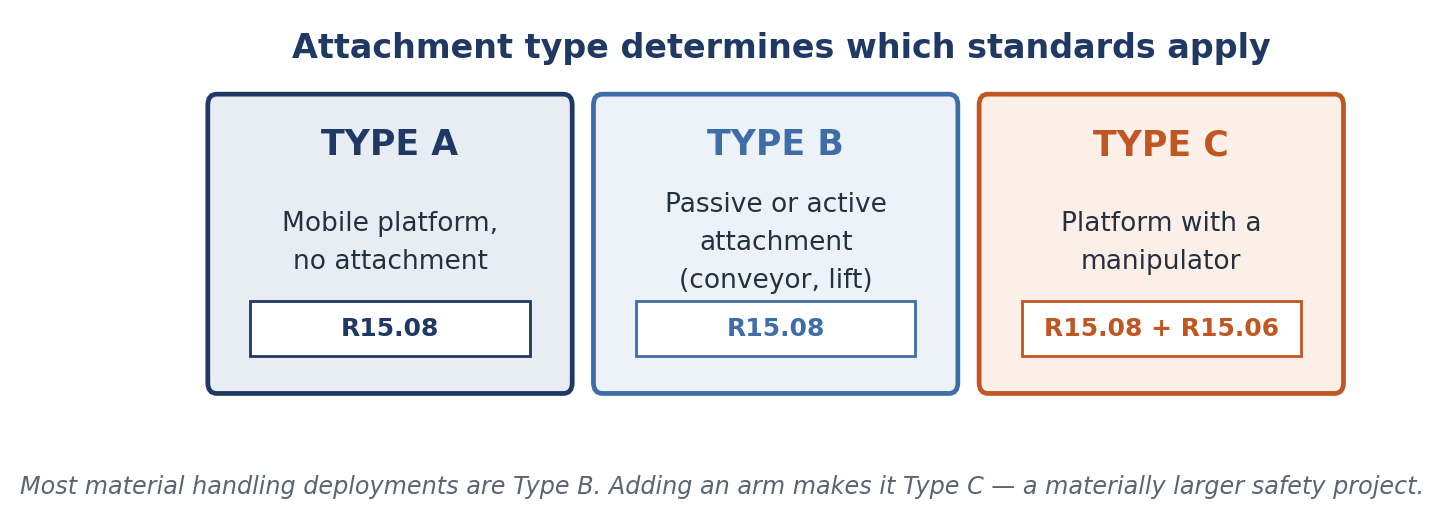
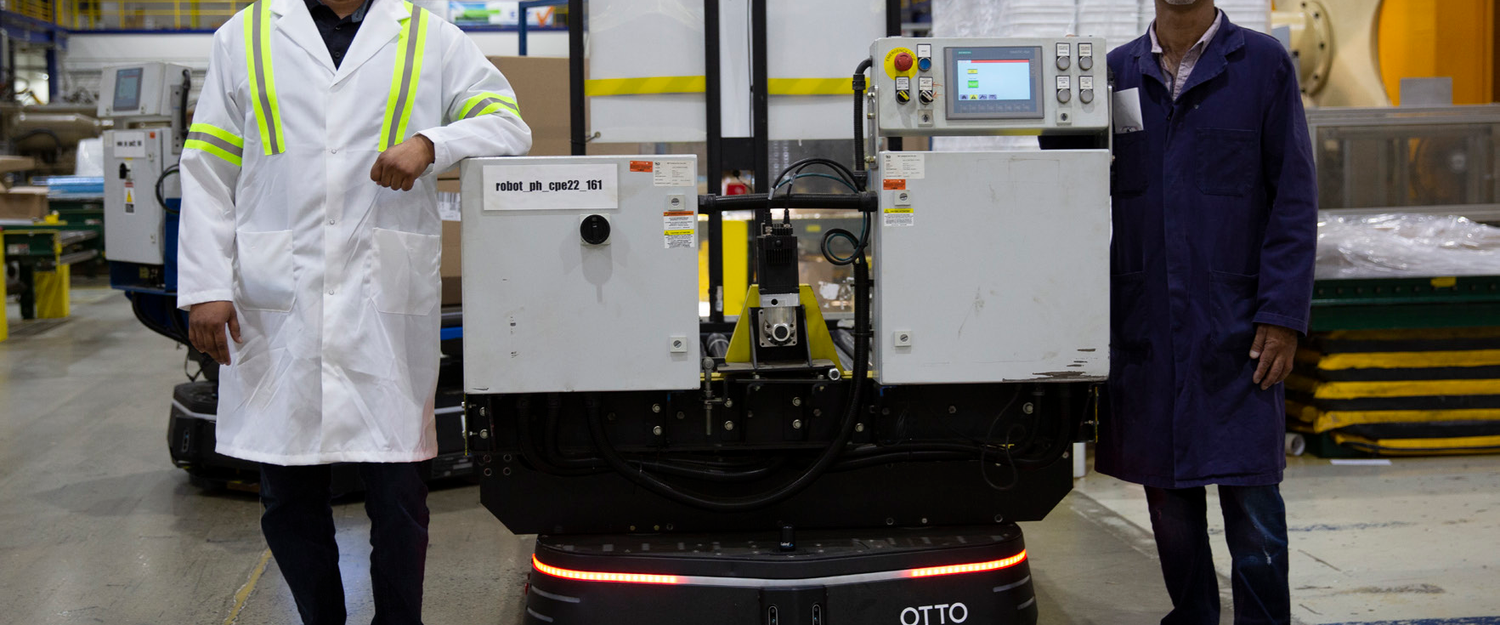
Most material handling deployments are Type B: a robot carrying a conveyor, a lift, or a custom fixture. The attachment is part of the safety case, not an accessory bolted on afterward.
Type C is where obligations expand. R15.08 requires manipulators on Type C machines to comply with R15.06, the US adoption of ISO 10218 — which sets performance requirements for safety-related control system parts at PL d with structure category 3 per ISO 13849-1, or SIL 2 with hardware fault tolerance of 1 per IEC 62061. If you're considering an arm on a mobile base, that's a materially different safety project than a transport AMR.
ISO 3691-4 and the requirements that land on your facility
ISO 3691-4 covers driverless industrial trucks and explicitly names autonomous mobile robots in scope. It applies to manufacturers and operators alike. The section that surprises people is Annex A, which is normative and covers preparation of the operating zone — requirements on the facility, not the robot, and the ones most likely to be discovered late.
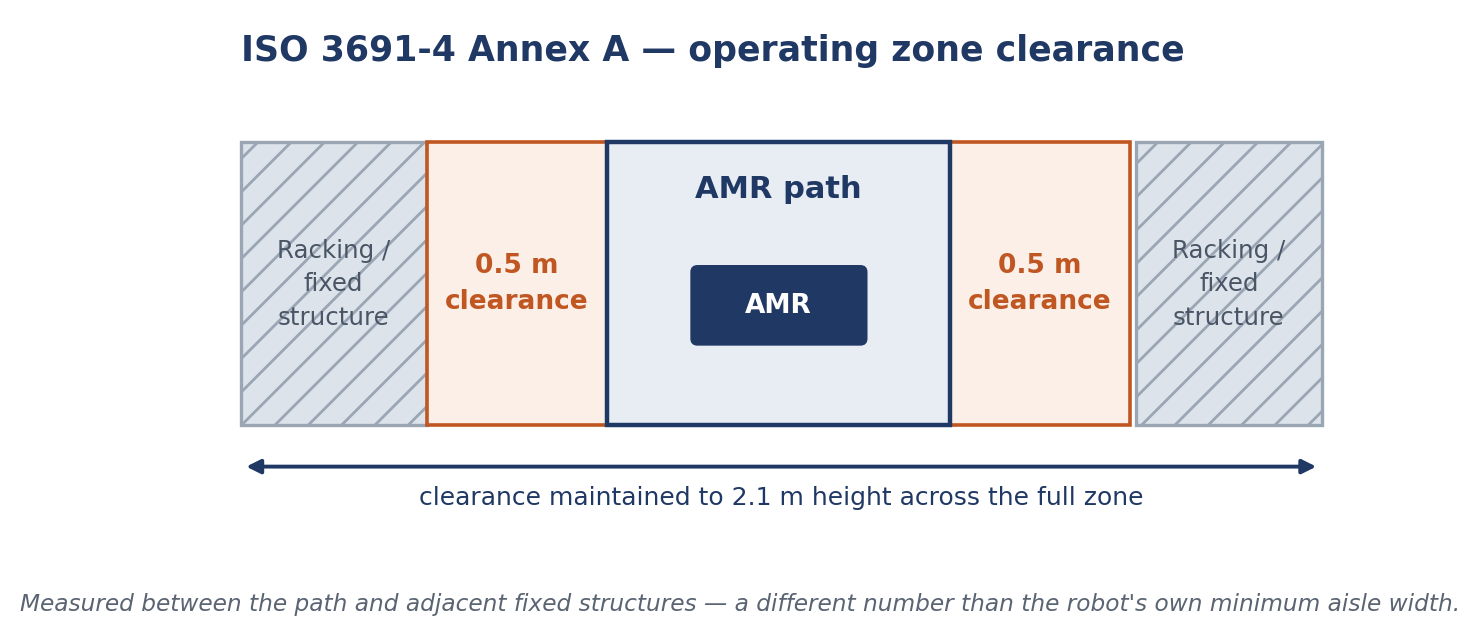
The zone requires a minimum 0.5 m clearance on both sides of the path, maintained to 2.1 m height, measured between the path and adjacent fixed structures. Where a person can be exposed to a hazard — inadequate clearance, or a zone personnel detection can't cover — the area becomes an operating hazard zone, with speed limited per the standard's tables and additional acoustic or optical warnings required.
Where clearance is inadequate and there's no pedestrian escape route of at least 0.5 m by 2.1 m, personnel detection must detect persons to within 180 mm between the edge of the ESPE safety fields and surrounding objects. If detection can't be implemented at all, an emergency stop must be installed within 600 mm of the hazardous point.
The practical consequence: an AMR deployment isn't only a robot purchase. It carries layout obligations — clearances, markings, escape routes, and in constrained areas additional detection or stopping devices. Those are best identified during layout review, not commissioning.
Where to start
One caution first: published standards lists vary between models within a single product line. That may reflect documentation timing rather than a real certification difference, but if a specific standard matters to your risk assessment, ask the manufacturer to confirm conformity in writing for the exact model and configuration you're buying.
- Classify the IMR type. Type A, B or C determines which standards apply and whether R15.06 enters the picture.
- Run a site-specific risk assessment. Under ISO 12100, covering the robot, the attachment, the workflows and the people who interact with them.
- Assess and prepare the operating zone. Walk the routes against the 0.5 m by 2.1 m clearance requirement, identify operating hazard zones, and specify what they need.
- Integrate, then validate. Define how the robot's E-Stop circuit ties into plant safety systems, then verify per ISO 3691-4 and R15.08's validation annexes.
The bottom line
Mobile robots are safe to work alongside people when the robot, the integration and the operating environment are all addressed. R15.08 divides those responsibilities deliberately, and compliant hardware covers only the first. The clearance requirements, zone preparation and risk assessment are yours — and far easier to handle during layout review than after the robots arrive.
Working through an AMR project and want help with the safety side? HESCO's team can support risk assessment, safeguarding design and standards conformance alongside the automation itself. Get in touch at hesconet.com/contact-us.
Topics: