Payload is the easiest spec to get right. A 900 lb load needs something rated above 900 lb, and that takes thirty seconds. What takes longer is everything that decides whether the robot works in your building: whether it fits the aisle you have, whether its charging matches your shift pattern, and whether your attachment can get power off it.
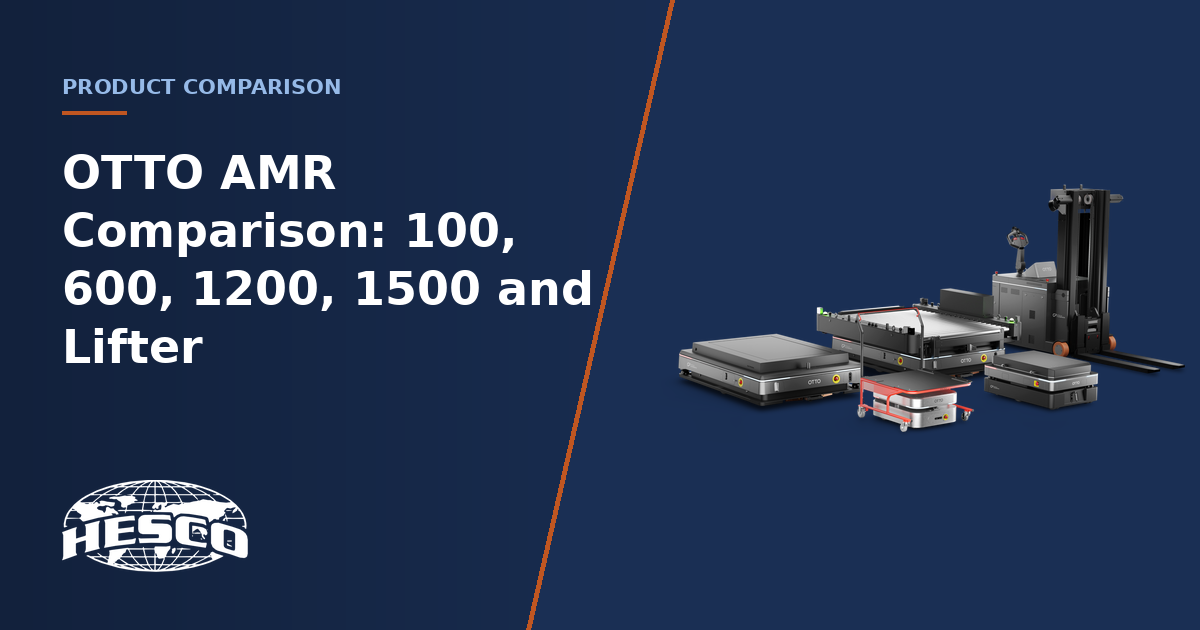
At HESCO we help customers evaluate material handling automation alongside the rest of their Rockwell architecture. This compares the five OTTO AMRs on the specs that actually determine fit.
The short version: the 100 and 1500 are the speed-and-endurance pair at opposite ends of the payload range, both at 2.0 m/sec. The 600 and 1200 are one platform in two sizes, sharing a 48 V system and 6,000-cycle battery. The Lifter is the outlier in nearly every category — it's a forklift, and it behaves like one.
The lineup at a glance
Four are flatbeds carrying a load on top of the chassis. OTTO Lifter is a forked AMR that picks pallets directly — a distinction that drives most of what follows.
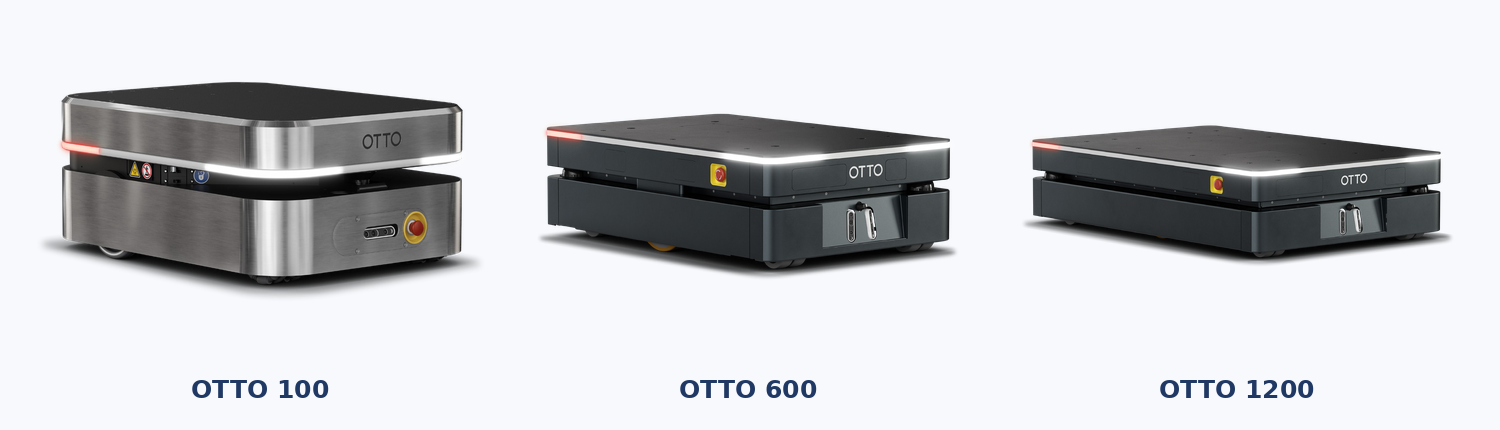
| Specification | OTTO 100 | OTTO 600 | OTTO 1200 | OTTO 1500 | OTTO Lifter |
|---|---|---|---|---|---|
| Max. capacity | 150 kg | 600 kg | 1,200 kg | 1,900 kg | 1,200 kg |
| Max. speed | 2.0 m/s | 1.4 m/s | 1.4 m/s | 2.0 m/s | 1.5 m/s |
| Footprint (mm) | 740 × 550 | 1,050 × 700 | 1,350 × 910 | 1,837 × 1,283 | 2,841 × 1,201 |
| Height (mm) | 308 | 320 | 320 | 351 | 2,155 |
| Min. aisle, 1-way | 1,099 mm | n/p | n/p | 1,915 mm | 3,152 mm |
| Turning | In place | In place | In place | In place | 1,985 mm auto. |
| Charge 10→90% | 18 min | 30 min | 30 min | 60 min | ~1 hr lithium |
| Battery life | 10,000 cyc | 6,000 cyc | 6,000 cyc | 3,000 cyc | n/p |
| Floor obstacle | 13 mm | 4 mm | 4 mm | 16 mm | n/p |
"n/p" means not published — OTTO's current data sheets don't state aisle width for the 600 and 1200, or runtime for the 600, 1200 and Lifter. Worth requesting rather than assuming. Capacity figures include the attachment, so usable payload is always lower.
Aisle width decides more projects than payload does
In a brownfield plant where the racking is in and the walls aren't moving, this is usually what eliminates options.
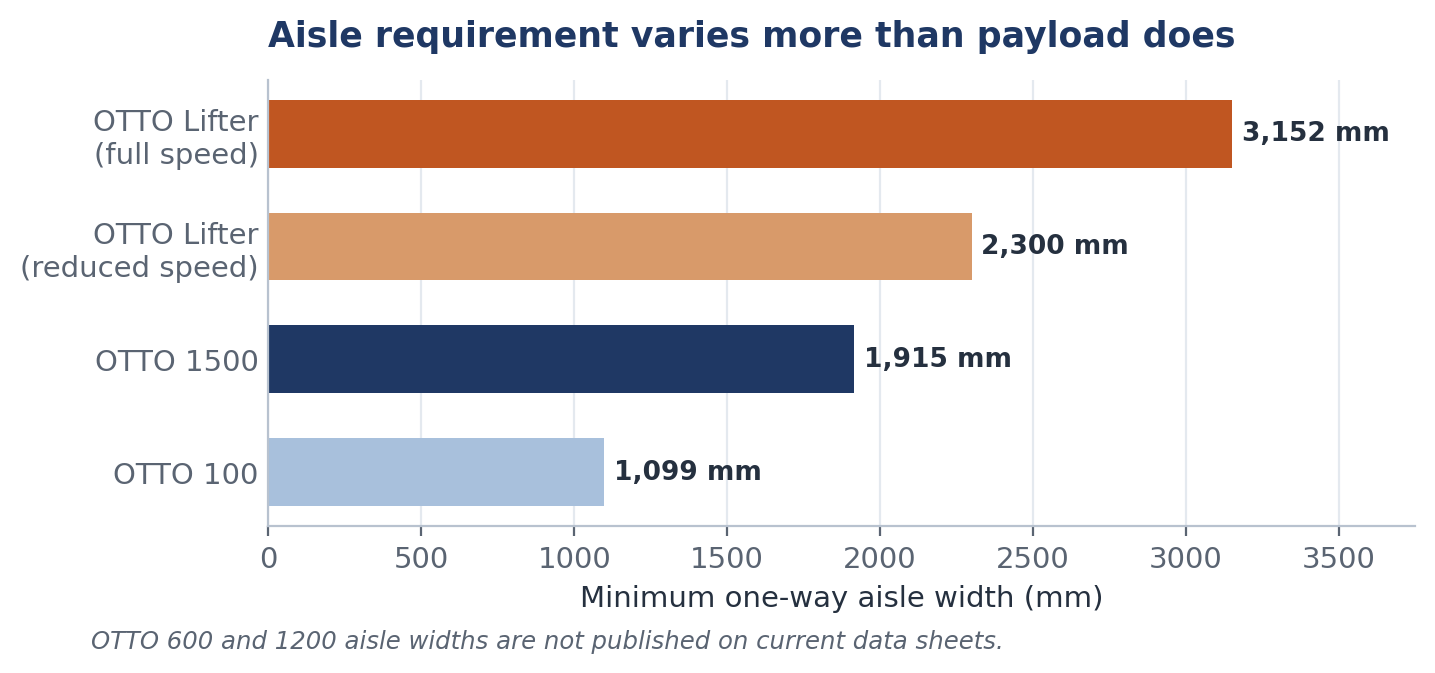
The Lifter can work in 2,300 mm one-way, but only at reduced speed — a throughput decision as much as a layout one. Height matters too: at 2,155 mm with forks down it's around seven feet standing still, where the flatbeds sit at 300–350 mm. Mezzanine underpasses and older doorways are a hard check before anything else.
Floor obstacle tolerance is a small number with real consequences. The 600 and 1200 clear 4 mm; the 1500 traverses 16 mm. Expansion joints, worn floor plates and trench drain covers are exactly what clears one robot and stops another. Walk the route with a straightedge.
Charging behavior, not runtime
All five default to autonomous opportunity charging — topping up between jobs rather than running flat and parking. That changes how you read the numbers: runtime is less a hard limit than an indicator of headroom between top-ups.
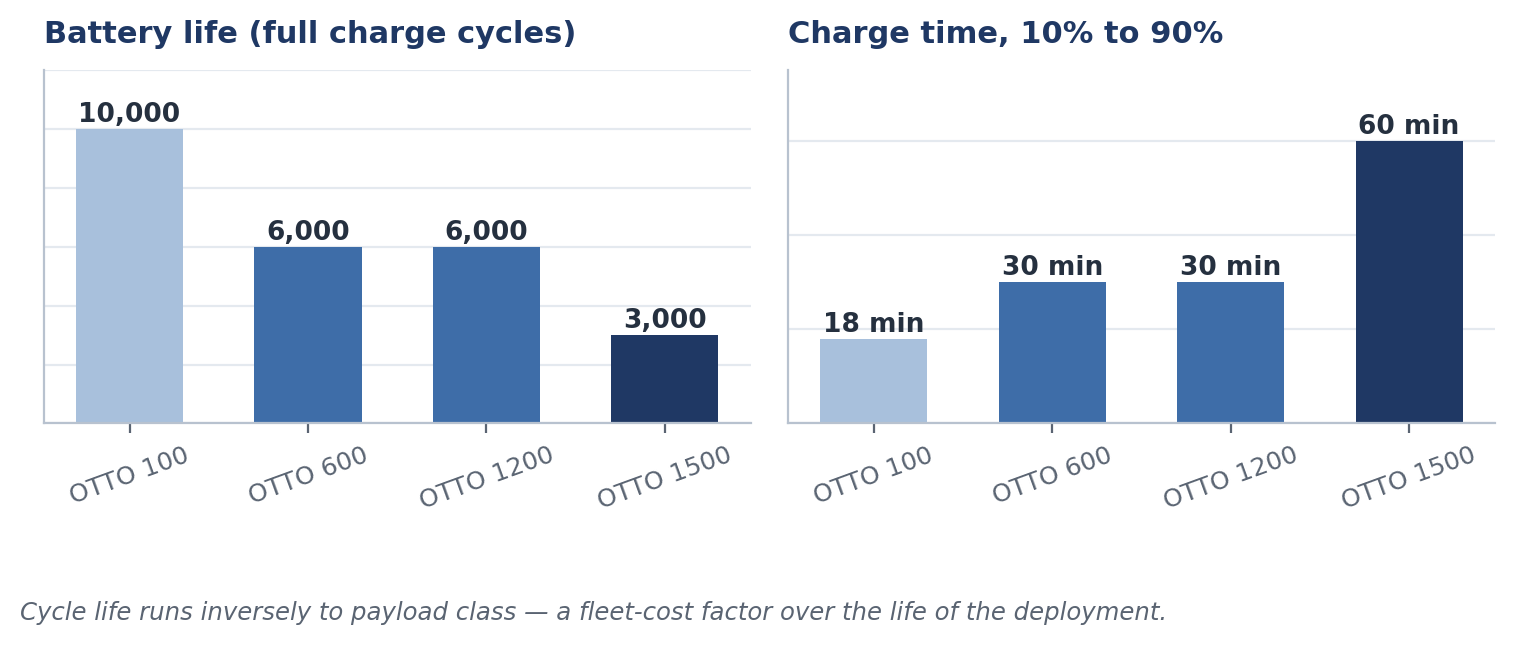
Two things stand out. Battery cycle life runs inversely to payload class — 10,000 cycles on the 100 against 3,000 on the 1500 — which compounds into different replacement schedules across a fleet running around the clock. And the 100 recovers from 10% to 90% in 18 minutes at 98 A, faster than anything else in the lineup despite the 1500 carrying a larger pack.
The Lifter is the exception again. It's the only lead-acid option, and the gap is large: roughly one hour on lithium via a 200 A supercharger against roughly six hours on lead-acid. That choice determines whether the unit runs continuously or needs a battery-swap process built around it.
Attachment interfaces differ by architecture
An AMR is rarely useful bare, and the interfaces are not variations on one connector. The OTTO 1500 provides 24 VDC at 10 A regulated plus 52.8 VDC at 50 A unregulated, with Ethernet, USB 3.1, HDMI, CAN bus and 5 GPIO of which 2 are safety-rated. The 600 and 1200 share a 48 V interface at 3 × 16 A. The OTTO 100 is different again — 26.4 VDC at 12 A with RS-232 rather than CAN.
An attachment designed against the 1500 won't port to the 100 without rework, so the model has to be locked before an attachment is designed or quoted.
The 100 has something the others don't: an integrated lift with 62 mm of stroke at full 150 kg capacity, designed to pair with an OTTO Cart. For cart-based lineside delivery and kitting, that removes the attachment question entirely.
OTTO Lifter: a different machine
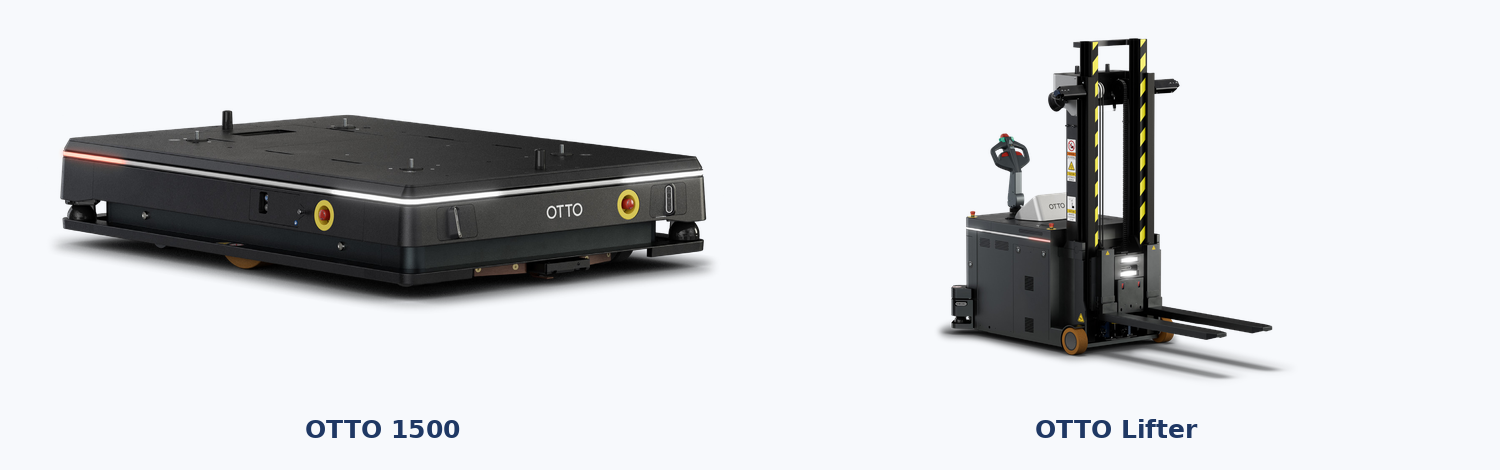
Three Lifter constraints are project-shaping. Autonomous lift height caps at 1.0 m even though the mast reaches 2.7 m in manual mode, so it moves pallets between floor locations, stands and machines — not into high racking. Max load height drops from 183 cm at 1,000 kg to 134 cm at 1,200 kg. And gradeability is limited to 1 degree, which rules out most ramps and some dock approaches.
The pallet spec is stricter than it first reads: Grade A wood pallets only, in 40 × 48 in or 45 × 48 in. Facilities running mixed or damaged pallet stock need to address that before deployment.
Narrowing the choice
- OTTO 100 — Human-scale loads under 150 kg, cart workflows, tight aisles, high cycle counts. The 1,099 mm aisle and 18-minute charge suit lineside delivery and kitting.
- OTTO 600 / 1200 — Mid-weight loads in confined space. Same platform, speed, battery and interface — the choice between them is purely payload and footprint.
- OTTO 1500 — Heaviest payloads, longest runtime, most capable attachment interface. Moves the most material per trip.
- OTTO Lifter — Pallets on the floor or on stands with no conveyor handoff. Replaces a forklift trip — but needs the aisle, the pallet discipline and the flat floor.
Most facilities end up with more than one model, since workflows in a single plant rarely share a payload class, and the fleet layer coordinates mixed models on the same floor.
Getting the spec right the first time
Payload narrows the field to two or three. Aisle width, floor condition, charging behavior and attachment interface narrow it to one — and those are the expensive ones to get wrong, because they surface after the robot is on site.
Ready to see where AMRs fit in your operation? Contact the HESCO team at hesconet.com/contact-us — we'll work through payload classes, aisle constraints and fleet sizing for your facility.

%20(1).png?width=1280&height=720&name=Cobot%20vs%20Robot%20copy%20(2)%20(1).png)