Machine Safety Services: Covering the Whole Lifecycle, Not Just the Audit
October 15th, 2026
4 min read
By Bryan Sample
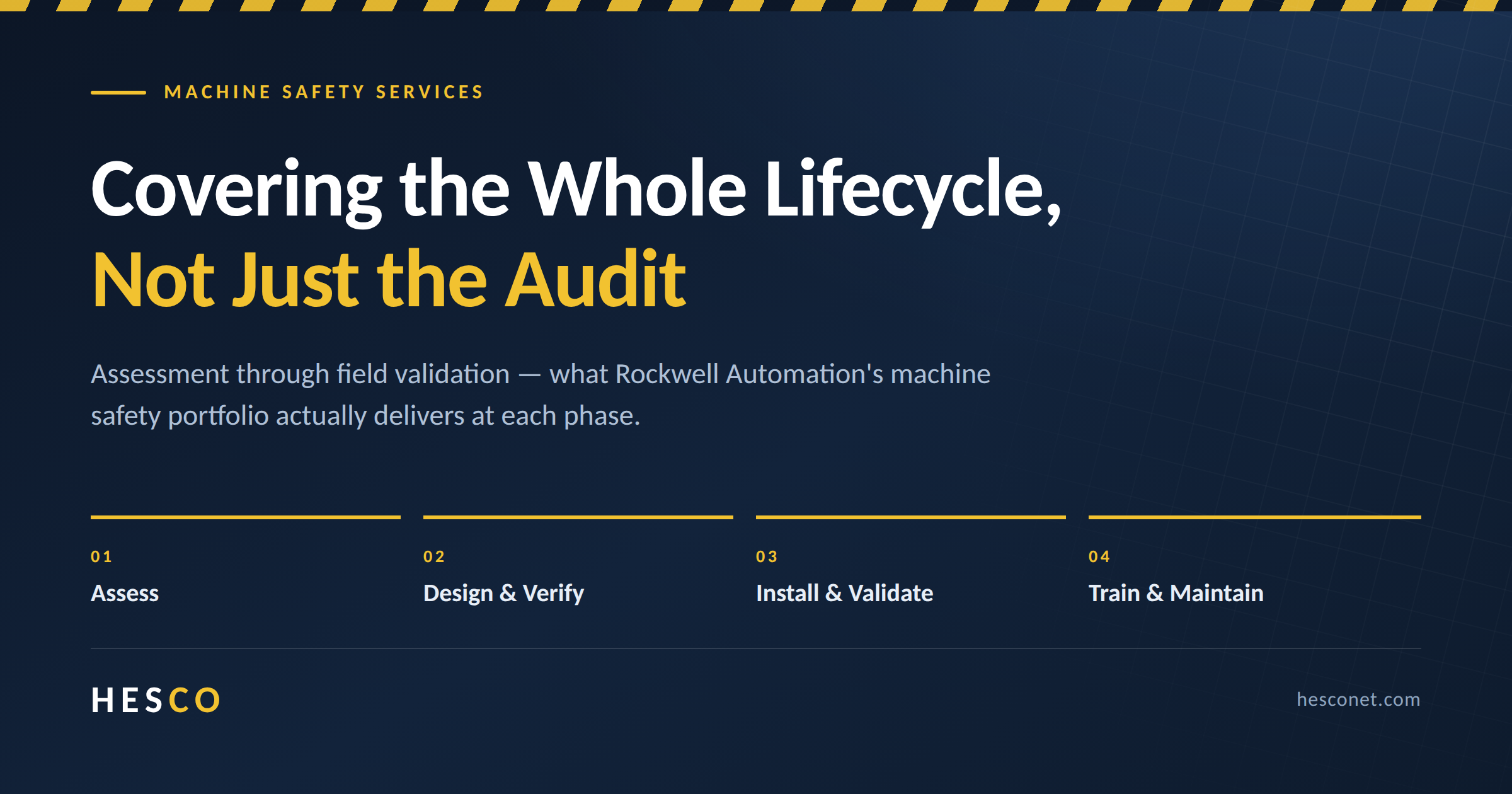
Most machine safety work starts reactive. An incident, an insurance review, a new line that has to pass before it can run — something forces the issue, and the response is a one-off: a guarding evaluation on the machine that caused the problem, or a validation pass on the cell holding up startup. The work gets done, but nothing connects it. Six months later the same plant buys another disconnected piece of the same puzzle.
The alternative is treating safety as a lifecycle. Rockwell Automation's machine safety services portfolio is organized that way, built around three outcomes plants actually get measured on: reduce risk, improve compliance, and optimize production. That last one matters more than it usually gets credit for. A safety system that's technically compliant but forces operators to defeat it isn't reducing risk; it's relocating it.
HESCO works with customers across that entire arc. Here's what's in the portfolio, what each phase produces, and where the handoffs are.
The short version: the portfolio breaks into four phases — scalable safety assessments, design and verification services (SFRS and Safety SISTEMA verification), installation and validation services (circuit analysis, stop time, conformance audits), and digital services and training (TÜV certification training, RASWin, ScanESC). Assessments are delivered by TÜV-certified safety consultants using a methodology based on current international standards. Each phase produces a documented deliverable that feeds the next one.
Start With a Scalable Safety Assessment
Assessments are the front end of the lifecycle, and the word that matters in "scalable safety assessments" is scalable. The mistake plants make here is running the same depth of assessment across every machine on the floor — either burning budget on team-based assessments for low-risk equipment, or running a thin audit on the one machine that warranted a deep look.
Rockwell offers four tiers, and they're meant to be mixed across a facility rather than chosen once:
| Assessment type | What it delivers | Where it fits |
|---|---|---|
| Conformity audit | High-level safety analysis of machines; shows compliance or noncompliance against pre-defined attributes | Baseline and triage — use it to prioritize and qualify which machines get deeper attention |
| Guarding evaluation | Hazard identification plus guarding recommendations for immediate action | Machines with known physical access issues where you need actionable direction fast |
| Risk assessment | Full assessment by a Rockwell safety engineer or consultant, including safety-improvement recommendations | Standard depth for most production equipment |
| Team-based risk assessment | Everything in a standard risk assessment, plus in-depth analysis for special or critical machines and structured knowledge transfer to your team | Critical or unusual machines — and any plant trying to build internal safety capability rather than outsource it permanently |
The team-based option is the one worth a second look if you're staffing a safety program long-term. The in-depth analysis is the deliverable, but the knowledge your maintenance and engineering people pick up sitting in that process is what makes the next assessment cheaper.
All of it is delivered by TÜV-certified consultants working from a methodology based on the most current international standards.
Design and Verification: Turning Findings Into a Specification
An assessment tells you what's wrong. It doesn't tell you what to build. That gap is where most safety projects go sideways — recommendations get handed to a controls group with no specification behind them, and the resulting design either overshoots or misses the intent.
The Safety Functional Requirement Specification (SFRS) is the bridge. Once a risk assessment is complete, the SFRS is used to review those recommendations and confirm the mitigation strategies are actually practical for your facility. Developing it isn't a desk exercise: a Rockwell consultant leads discussions across your safety, engineering, operations, and management teams to verify the plan achieves the safety goals without impeding production and maintenance. That cross-functional step is the point. It's how you catch the guard door interlock that satisfies the standard and stops the line every shift change.
The approved SFRS then does double duty. It becomes the basis for the risk mitigation engineering design, and it becomes the basis for field validation later — the document you test against when the system is installed.
On the circuit side, Safety SISTEMA Verifications review safety-circuit design for compliance to a specified Performance Level, confirming that safety devices are properly applied to protect personnel.
Installation and Validation: The Real Test
Validation is where a safety system stops being a drawing. Rockwell's safety system validation services confirm proper installation and functionality, and the scope is broader than most people expect. These services evaluate:
- Circuit performance
- Fault tolerance and fault action
- Software logic
- Device application and device function
- Reset actions across all modes of operation
That last one is the item that catches installations. A system that behaves correctly in auto mode and fails in manual or setup mode is a system that hasn't been validated. The services cover both U.S. and European community-based designs and can be tailored to scope.
Specific services under this phase include safety circuit analysis, machine stop time services, normative conformance audits, and full safety system validation. Stop time measurement is the one to schedule early if you're placing light curtains or presence-sensing devices — safety distance calculations depend on it, and measuring after the guarding is mounted is an expensive way to find out you're short.
Remediation is flexible. If you're executing with your own resources, Rockwell can provide project management and support through the process. If you'd rather hand it off, TÜV-certified safety engineers can deliver the work turnkey at your site.
Digital Services and Training: Keeping It Current
Safety documentation goes stale. Machines get modified, guards get moved, and the risk assessment in the binder stops describing the machine on the floor. Two tools in the portfolio address that maintenance problem directly:
- RASWin (Risk Assessment Software for Windows) — develops and maintains machine functional safety documentation, so the assessment is a living record rather than a PDF from three years ago.
- ScanESC — lockout/tagout software aimed at achieving safety compliance, reducing risk, and improving productivity.
Training rounds it out, covering current and anticipated industry standards and guidelines along with application examples for applying safety components, including TÜV certification training.
Where to Start
If you’re not sure which end of this to pick up, start with a conformity audit across the floor and let the results tell you where the deeper assessments belong. If you already have assessment findings sitting in a report that nobody has turned into a design, the SFRS is your next step. And if you have a safety system installed but never formally validated, the validation services are the fastest way to find out what you actually have.
HESCO can help you scope the right entry point and connect you with Rockwell Automation's machine safety services team. Reach out and we'll work through where your program stands and what the next phase should be.
Topics:



%20(1).png?width=1280&height=720&name=Cobot%20vs%20Robot%20copy%20(2)%20(1).png)