Ball Screw Jacks: Efficiency, Ball Nut Life, and What Changes in the Drivetrain
October 5th, 2026
4 min read
By Bryan Sample
The motor keeps tripping. Or the gearbox is a frame size larger than the panel allowed. Or the jack housing is too hot to touch two hours into a shift. All three usually point at the same cause: a machine screw jack running a duty cycle it was never meant to run, turning most of the input energy into heat instead of work.
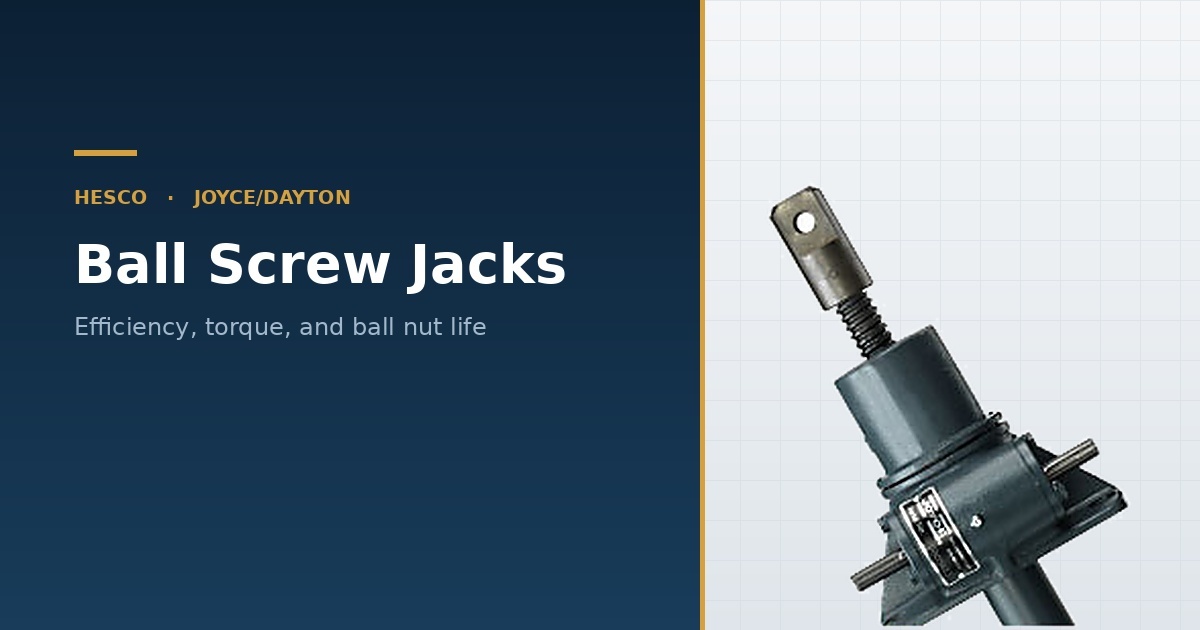
Ball screw jacks fix that by replacing sliding friction with rolling friction, and the numbers aren’t marginal. At HESCO, we work through screw jack selection for conveyor, packaging, material handling, and process applications — and this conversation usually starts with motor sizing, not with the jack.
The short version: Joyce/Dayton worm gear ball screw jacks run 1 to 50 tons, use ball nuts that are roughly 90% efficient, and require up to two-thirds less input torque than a comparable machine screw jack. In exchange, they are not self-locking in any configuration — a brake motor or external locking device is required, not recommended — and ball nut life is a finite, calculable number that should drive model selection as much as capacity does.
Where the Efficiency Comes From
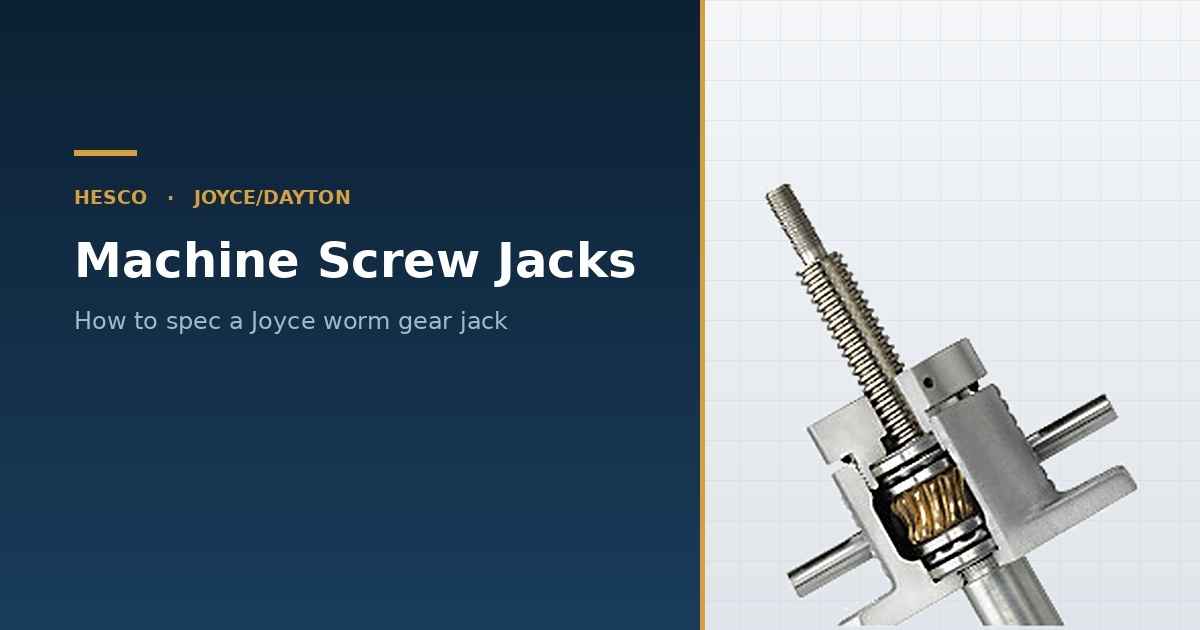
Joyce/Dayton’s 10-ton models make a genuinely controlled comparison possible. The WJ810 and the heavy-duty WB810 share a 2-inch screw, a .500 lead, an 8:1 worm gear ratio, and 16 worm shaft turns per inch of travel. The only meaningful difference is a bronze nut sliding on an Acme thread versus a recirculating ball nut.
| 10 ton, 2" screw, .500 lead, 8:1 | WJ810 (machine screw) | WB810 (ball screw) | Change |
|---|---|---|---|
| Efficiency rating | 23.1% | 50.7% | 2.2× |
| Starting torque | 0.061 × load | 0.023 × load | −62% |
| Operating torque @ 200 RPM | 0.043 × load | 0.019 × load | −56% |
| Worm shaft turns per 1" | 16 | 16 | no change |
| Self-locking | Yes | No — brake required | — |
Torque figures are coefficients: multiply by the load in pounds, then add 20 in-lb tare. Source: Joyce/Dayton published specifications.
At the full 20,000 lb rating, the machine screw jack needs 1,240 in-lb to start; the ball screw jack needs 480 in-lb. That difference shows up as a smaller motor, a smaller reducer, smaller line shafting on multi-jack systems, and less heat in the jack.
Note what doesn’t change: travel speed. Both move 1 inch per 16 worm shaft revolutions. Efficiency is not speed — if you need the load to move faster, the lever is lead.
Not Self-Locking Is a Design Constraint, Not a Footnote
Every Joyce/Dayton ball screw jack will backdrive under load. Joyce/Dayton is explicit that brake motors or external locking systems are required and that hand wheels are not a recommended option — a hand wheel on a backdrivable jack is a spinning hazard the moment the operator lets go.
The spec that sizes the brake is worm holding torque, published per model — 180 in-lb on a WB810 at full rating, 1,300 in-lb on a 50-ton WB1150. Two consequences follow: a power loss becomes a motion event unless the brake is fail-safe, and on multi-jack systems braking at one motor puts shaft wind-up in the holding path. Where a load must hold for long periods without power, a machine screw jack is still the simpler architecture.
Standard Lead vs. High Lead: Buying Speed
High lead HWB and HWBL models use a 1.0" lead and are offered on the 2-ton, 5-ton, and 10-ton sizes only. The effect on travel is substantial, and the cost is visible in the same table.
| Model | Capacity | Lead | Turns per 1" | Efficiency | Ball nut life at rated load |
|---|---|---|---|---|---|
| WB62 | 2 ton | 0.25 | 24 | 52.1% | 642,000 in. |
| HWB62 | 2 ton (high lead) | 1.0 | 6 | 52.1% | 190,000 in. |
| WB65 | 5 ton | 0.474 | 12.66 | 51.1% | 1,015,000 in. |
| HB65 | 5 ton (high lead) | 1.0 | 6 | 51.1% | 512,000 in. |
| WBL810 | 10 ton | 0.474 | 16.88 | 50.7% | 127,000 in. |
| WB810 | 10 ton (heavy duty) | 0.5 | 16 | 50.7% | 729,000 in. |
Ball nut life is expressed in inches of screw travel at the jack’s rated load. Source: Joyce/Dayton published specifications.
At a 500 RPM input, a WB62 covers 20.8 inches per minute and an HWB62 covers 83.3 — same efficiency, four times the travel. What changes is torque, climbing from 0.015 to 0.064 × load, and ball nut life, dropping from 642,000 to 190,000 inches. Speed is bought with motor size and service life, both quantified up front.
Ball Nut Life Is the Spec Machine Screw Jacks Don’t Have
This is the most useful and most overlooked column on the sheet. Joyce/Dayton publishes a calculated ball nut life for every model, and JAX Online refines it for your load and duty cycle. A machine screw jack has no equivalent — its bronze nut wears progressively, managed by adjusting an optional anti-backlash device.
So two jacks identical on every other spec can have wildly different service lives. The 1-ton WBL51 and WB51 match on capacity, screw diameter, lead, ratio, torque, and efficiency — and differ 108,000 inches against 858,000. That gap is the entire meaning of the heavy-duty designation. Remember that the service life figure is at rated load: running below capacity extends it, often the lowest cost way to buy life.
Backlash and What’s Not Available
Ball screw jacks can’t use the anti-backlash devices offered for machine screw jacks. Joyce/Dayton’s answer is oversized ball bearings, limiting screw backlash to 0.003", or preloaded ball nuts in KFTN assemblies. That’s tighter than the 0.008"–0.015" typical of machine screw designs — but it’s set at build, with no field adjustment for wear.
One more gap worth knowing: ball screw jacks cannot be keyed for non-rotation the way machine screw jacks are, and it isn’t a standard option. If your application needs the screw restrained internally, Joyce/Dayton asks you to contact them for a design solution. In our experience, this single detail redirects more applications back to machine screw jacks than efficiency redirects the other way.
The Bottom Line
A ball screw jack is the right answer when duty cycle, motor budget, or drivetrain size constrains the design — and the wrong answer when the load must hold without a brake or the screw needs internal rotation restraint. The efficiency gain is real and better than double. The costs are equally concrete: a required brake, a probabilistic ball nut life to calculate before ordering, and a keyed option that isn’t standard.
Trying to decide whether the efficiency is worth the brake? The HESCO team can run the torque and ball nut life numbers against your actual load and duty cycle. Get in touch and let’s work through it together.
Topics:





%20(1).png?width=1280&height=720&name=Cobot%20vs%20Robot%20copy%20(2)%20(1).png)