If you're evaluating collaborative robots for the first time, the hardest part usually isn't deciding whether a cobot fits your operation. It's figuring out which one. Payload and reach get most of the attention, but the model that's right for a machine-tending cell on a benchtop is rarely the one you'd put on the floor to palletize cases to two meters. Pick wrong, and you either overpay for capability you'll never use or discover mid-integration that the arm can't reach the far corner of the work envelope.
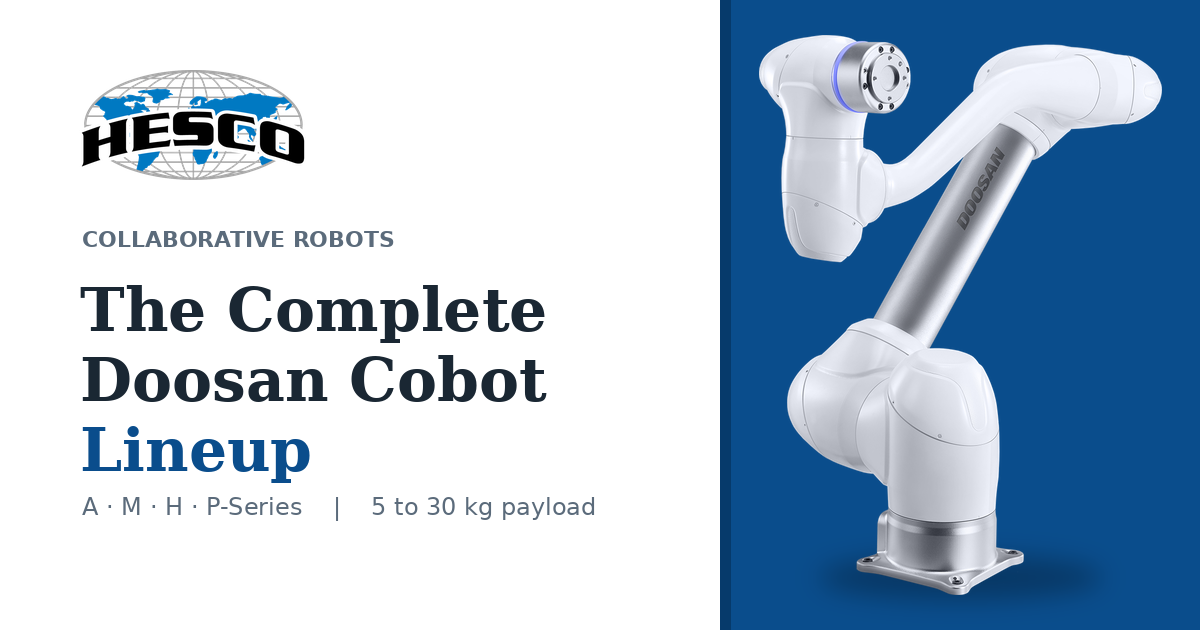
Doosan Robotics addresses that with one of the broadest cobot portfolios on the market: four series spanning roughly 5 kg to 30 kg of payload, each tuned to a different class of work. At HESCO, we help teams across manufacturing, material handling, and process industries match a cobot to the application rather than the spec sheet. This article walks the full Doosan lineup—what separates each series, where the individual models land on payload and reach, and the platform features every Doosan cobot shares—so you can narrow the field before you ever request a quote.
Here's the short version: the A-Series is the agile, lightweight entry point; the M-Series is the versatile workhorse covering the widest range of tasks; the H-Series brings heavy payload and long reach for serious lifting; and the P-Series, represented by the P3020, is a purpose-built palletizing specialist. All of them ride on a common control and safety architecture, which matters more than it sounds—it means the programming skills and integration work you invest in one model transfer directly to the others.
What Every Doosan Cobot Shares
Before getting into the series differences, it's worth understanding the platform underneath them, because it's where a lot of the real integration value lives.
Every Doosan collaborative robot is a six-axis arm (the P3020 is the exception, more on that below), rated IP54 for protection against dust and splashing water, with an operating temperature range of 0–45 °C and noise output under 65 dB. Repeatability runs from ±0.03 mm on the precision-oriented models to ±0.1 mm on the heavy-payload arms. Tool speed exceeds 1 m/s across the board.
On the safety side, Doosan cobots carry PL e, Category 4 functional safety certification—the highest level under ISO 13849—which supports faster safe-response times and simplifies the risk assessment for collaborative operation. Six joint torque sensors give the arms force sensitivity down to 0.2 N, fine enough to detect subtle contact and run genuine collaborative applications alongside people. A configurable collaborative zone can be tied to a safety scanner to automatically drop the robot into reduced-speed mode when someone enters the space, and the low arm mass contributes to short braking distances during Category 0 and Category 1 emergency stops.
Connectivity is where these cobots earn their place in an existing line. Every model supports EtherNet/IP, PROFINET, Modbus TCP, Modbus RTU, TCP/IP, and serial RS-232/RS-422/RS-485—which covers the major fieldbus and PLC ecosystems you're likely already running, whether the cell is anchored by an Allen-Bradley, Siemens, or other controller. On the programming side, Doosan's DART-Suite provides a drag-and-drop app-based interface, while the Teach Cockpit allows two-handed guided teaching. Notably, Doosan is one of the few major robotics vendors to support open-source standard languages like Python, which is a real advantage for teams that want to script complex logic rather than work strictly within a proprietary pendant environment.
One more design detail worth calling out: the curved forearm gives Doosan arms a centered flange, producing a symmetrical workspace and better reach at the boundaries of the work envelope—useful when you're trying to squeeze full coverage out of a tight cell.
A-Series (Agile): Lightweight and Fast
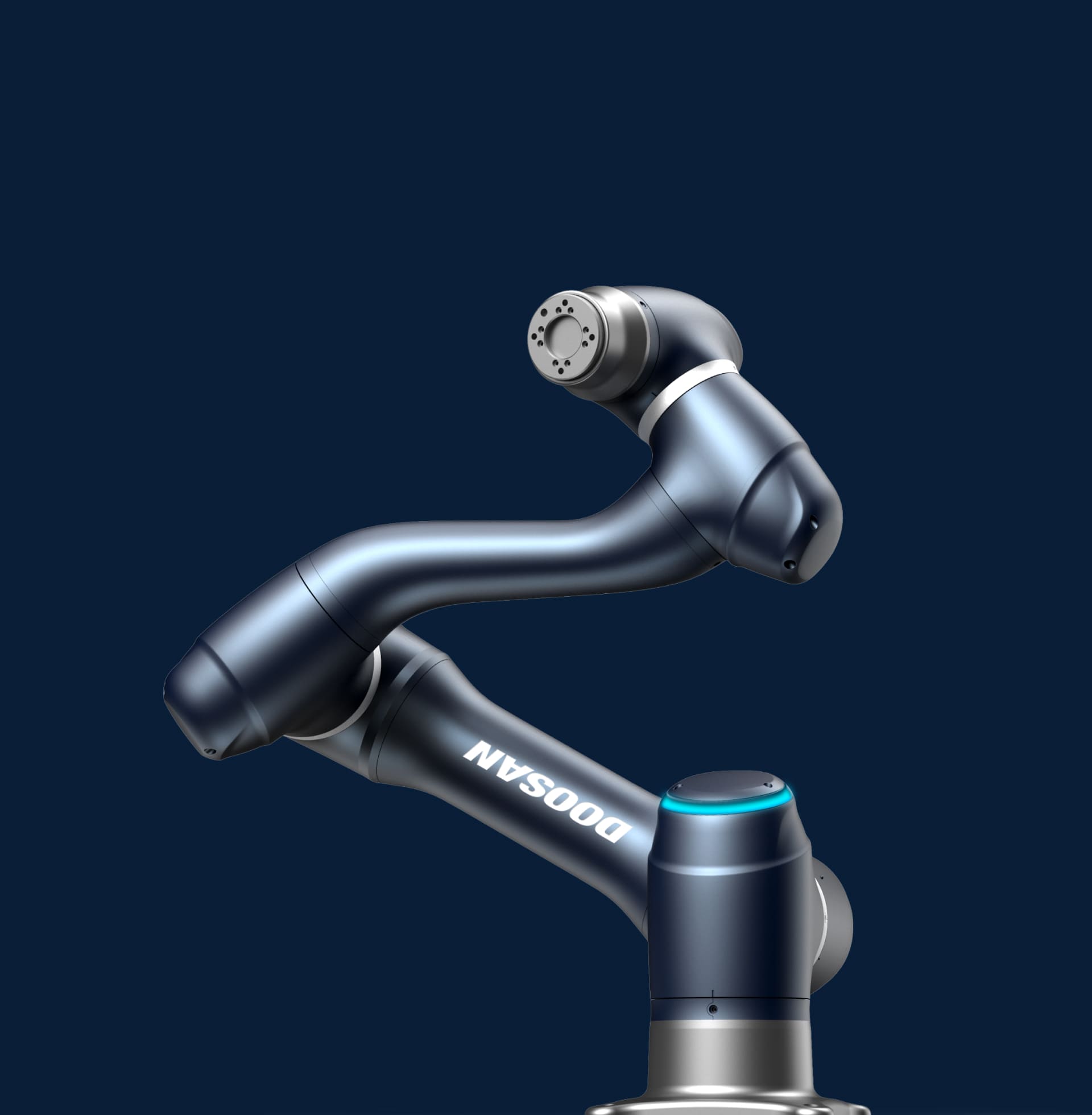
The A-Series is the natural starting point for lighter-duty work—pick-and-place, inspection, air blowing, gluing and bonding—where speed and a small footprint matter more than raw lifting power. Both models mount in any orientation, so you can floor-, wall-, or ceiling-mount them to fit the cell.
- A0509 — 5 kg payload, 900 mm reach, 21 kg arm weight, ±0.03 mm repeatability, 370 W
- A0912 — 9 kg payload, 1,200 mm reach, 31 kg arm weight, ±0.05 mm repeatability, 440 W
The A0509 is the lightest arm in the lineup, which makes it easy to redeploy between stations. The A0912 trades a little of that agility for meaningfully more reach and payload, bridging toward M-Series territory.
M-Series (Masterpiece): The Versatile Workhorse
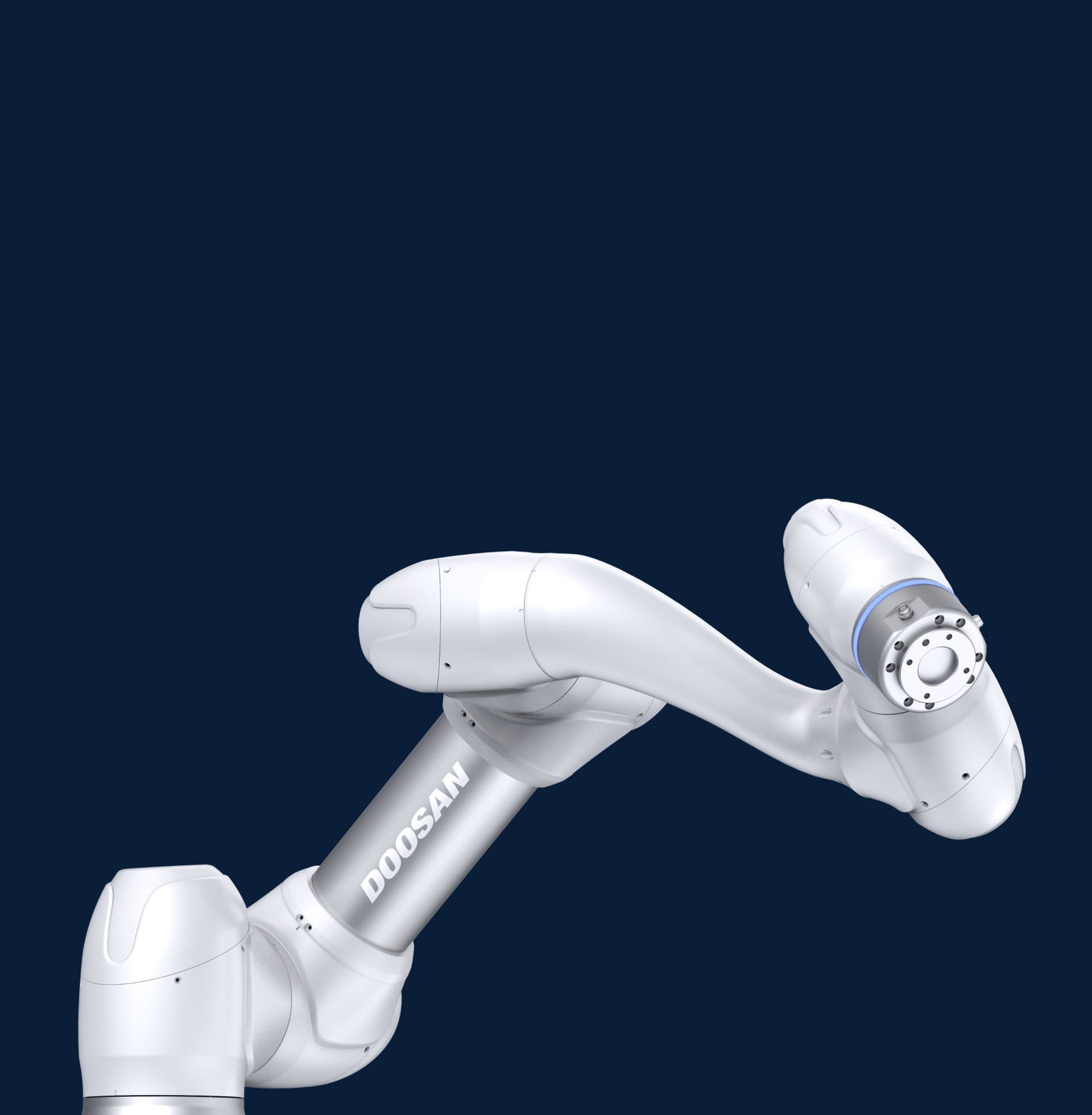
The M-Series is the broadest family in the lineup and the one most teams should look at first, because it covers the widest span of applications: assembling power tools, machine tending, welding, polishing and deburring, palletizing, gluing and bonding, plastic injection support, and press forming. Like the A-Series, every M-Series model mounts in any orientation.
- M0609 — 6 kg payload, 900 mm reach, 27.5 kg weight, ±0.03 mm repeatability, 370 W
- M1013 — 10 kg payload, 1,300 mm reach, 34 kg weight, ±0.05 mm repeatability, 390 W
- M1509 — 15 kg payload, 900 mm reach, 33 kg weight, ±0.03 mm repeatability, 390 W
- M0617 — 6 kg payload, 1,700 mm reach, 35.5 kg weight, ±0.1 mm repeatability, 390 W
The spread here is the point. The M0609 is a compact, high-precision all-rounder. The M1509 keeps that tight ±0.03 mm repeatability but pushes payload to 15 kg in the same 900 mm reach envelope—strong for higher-force tasks in a confined space. The M0617 goes the other direction, stretching reach to 1,700 mm while keeping payload modest, which suits large work envelopes where you're moving lighter parts across a wide area. The M1013 sits in the middle as a balanced general-purpose choice.
H-Series (High-Powered): Heavy Payload and Long Reach
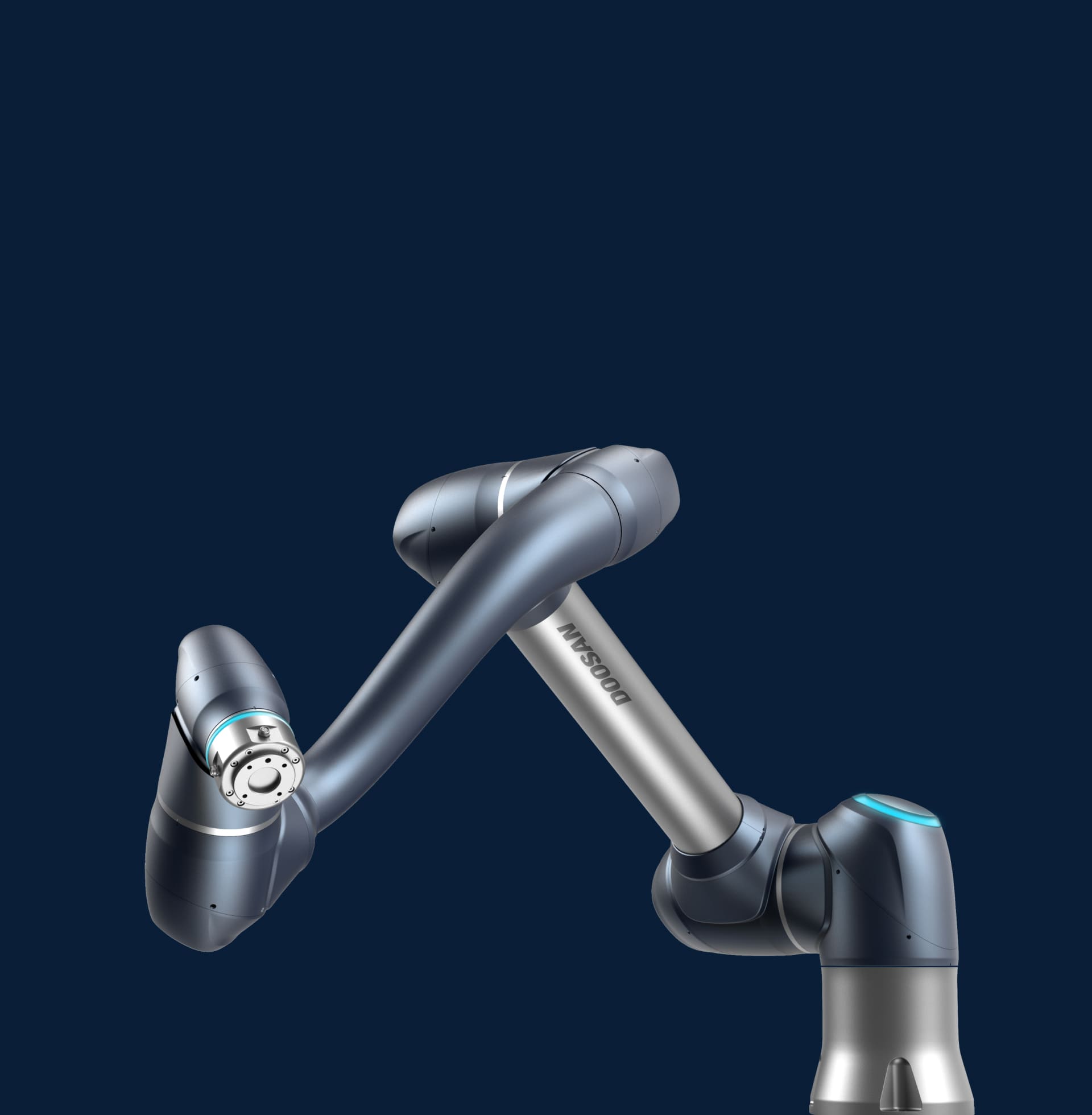
When the job involves real weight—palletizing heavier cases, machine tending with large parts, assembling automotive bodies, welding, or managing heavy objects—the H-Series is built for it. The trade-off is that these are substantially larger, heavier arms that mount to the floor rather than in any orientation.
- H2017 — 20 kg payload, 1,700 mm reach, 79 kg weight, ±0.1 mm repeatability, 290 W
- H2515 — 25 kg payload, 1,500 mm reach, 77 kg weight, ±0.1 mm repeatability, 290 W
Two things stand out. First, despite the jump in payload, power consumption actually drops to 290 W—lower than most of the lighter arms—which speaks to the efficiency of the drive design. Second, the choice between the two models is a reach-versus-payload decision: the H2017 gives you 200 mm more reach, while the H2515 adds 5 kg of payload in a slightly shorter envelope. Joint speeds are lower than the lighter series (J1 at 100°/s versus 150–180°/s on the smaller arms), which is the expected consequence of moving more mass safely.
P-Series (Prime): The Palletizing Specialist

The P3020 is a different kind of machine. Where the other series are general-purpose six-axis arms, the P3020 is a five-axis design optimized specifically for palletizing, and it's the heavy hitter of the lineup: 30 kg payload and a 2,030 mm reach that lets it stack a 30 kg load (including a typical 3–5 kg vacuum gripper) up to 2 meters high using a standard base—no lift required.
- P3020 — 30 kg payload, 2,030 mm reach, 83 kg weight, ±0.1 mm repeatability, 307 W, 5-axis, 6 m cable
The five-axis architecture is a deliberate choice: palletizing rarely needs the sixth degree of freedom, and dropping it buys greater stability and faster cycle times for stacking work. Power consumption sits at 307 W—Doosan positions this as roughly 25% lower than a comparable cobot in its class—and the reach is sized to work with standard Korean, European, and U.S. pallets. If end-of-line palletizing is your problem, this is the arm built to solve it.
How to Narrow It Down
A rough decision path: if your parts are light and cycle speed matters, start with the A-Series. If you need one platform that can flex across assembly, tending, finishing, and light palletizing, the M-Series is almost always the right first look. If you're lifting heavy parts or working a large envelope on the floor, move to the H-Series. And if the application is dedicated palletizing, the P3020 is purpose-built for it. Because every model shares the same control architecture, safety rating, connectivity, and programming tools, you can standardize your integration approach across an entire mixed fleet—which lowers training cost and spare-parts complexity over time.
The Bottom Line
The strength of the Doosan lineup is range: four series and nine models that share a common platform but specialize at the edges, so you can match the arm to the work instead of compromising. Spec sheets get you partway, but the right choice usually comes down to the details of your cell—reach into the far corner, mounting orientation, gripper weight, and how the cobot talks to the controller already on your line.
This overview is the starting point. We're following it with deeper dives into each series—the A-Series, M-Series, H-Series, and P-Series—comparing their strengths, weaknesses, and the applications where each one pulls ahead. In the meantime, if you want help matching a Doosan cobot to a specific application, the HESCO team can walk you through payload, reach, mounting, and integration for your environment. Reach out and let's work through it together.
Topics:
