Not every automation problem needs a big arm. A surprising amount of the work that justifies a cobot in the first place—loading small parts, running inspections, dispensing adhesive, blowing off a fixture—involves payloads under 10 kg and a premium on speed and flexibility rather than brute force. Put a heavy, floor-bolted arm on that kind of job and you've overspent on capability you'll never touch while giving up the redeployability that made the cobot attractive to begin with.
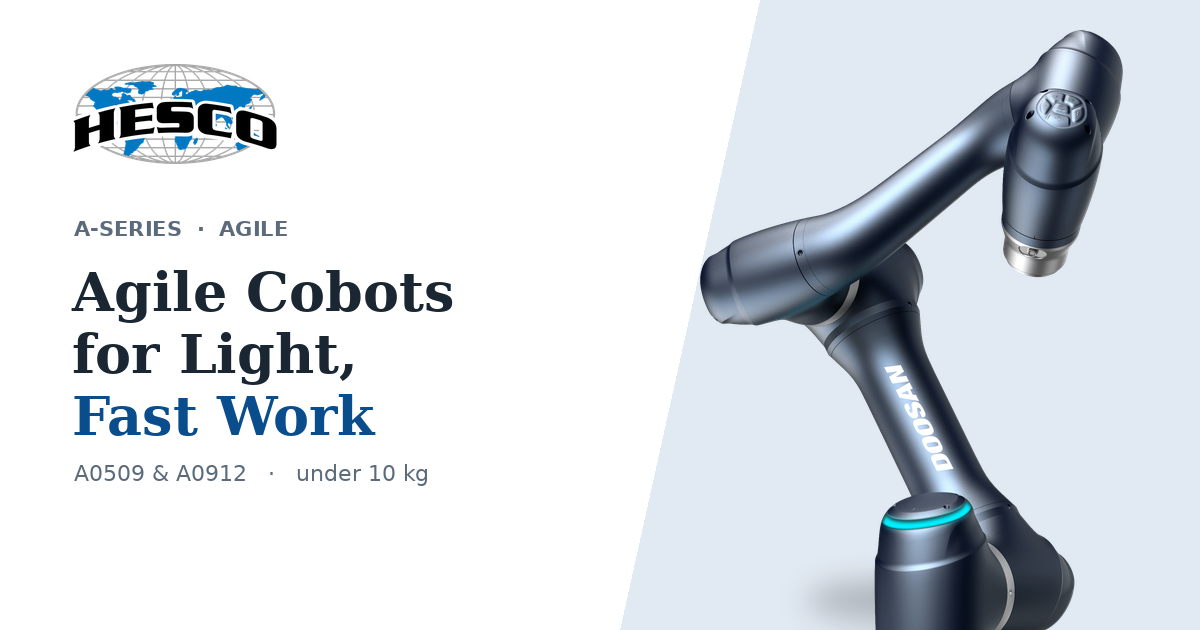
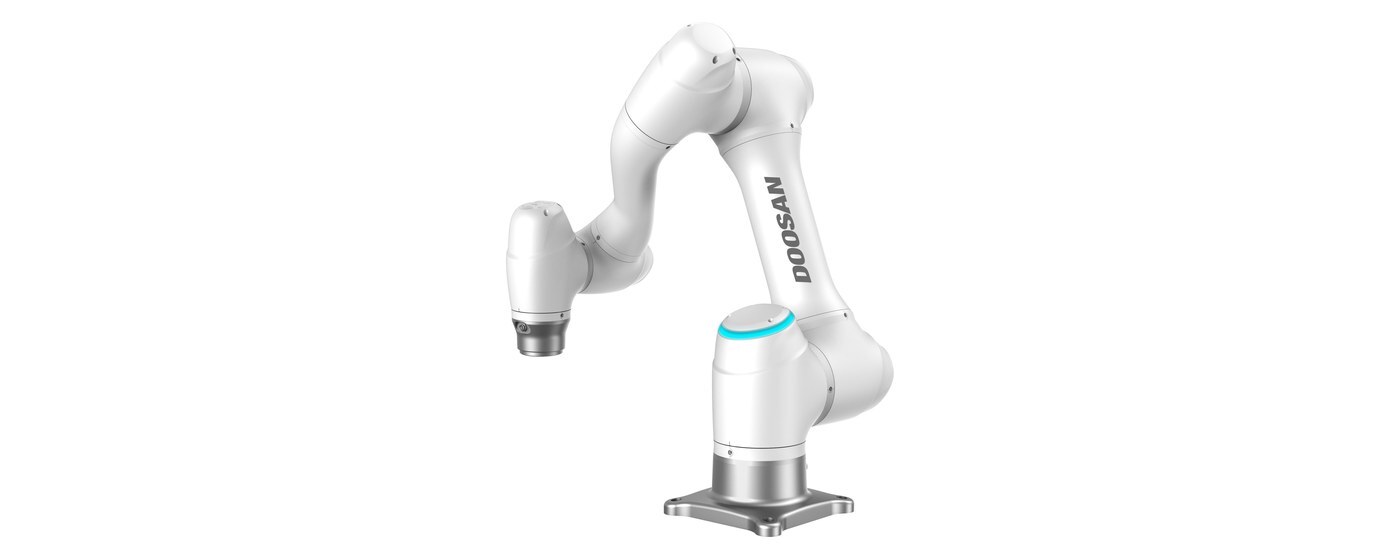
That's the gap the Doosan A-Series fills. Branded "Agile," it's the lightweight end of the Doosan collaborative robot lineup: two six-axis models built for fast, precise, lighter-duty tasks that you may want to move between stations as production needs shift. At HESCO, this is often where we point teams running their first cobot pilot, because the A-Series keeps the footprint small and the deployment simple without giving up the platform features that make Doosan arms worth integrating. This article covers what the A-Series is designed to do, where it fits, and how to think about implementation.
What the A-Series Is Built For
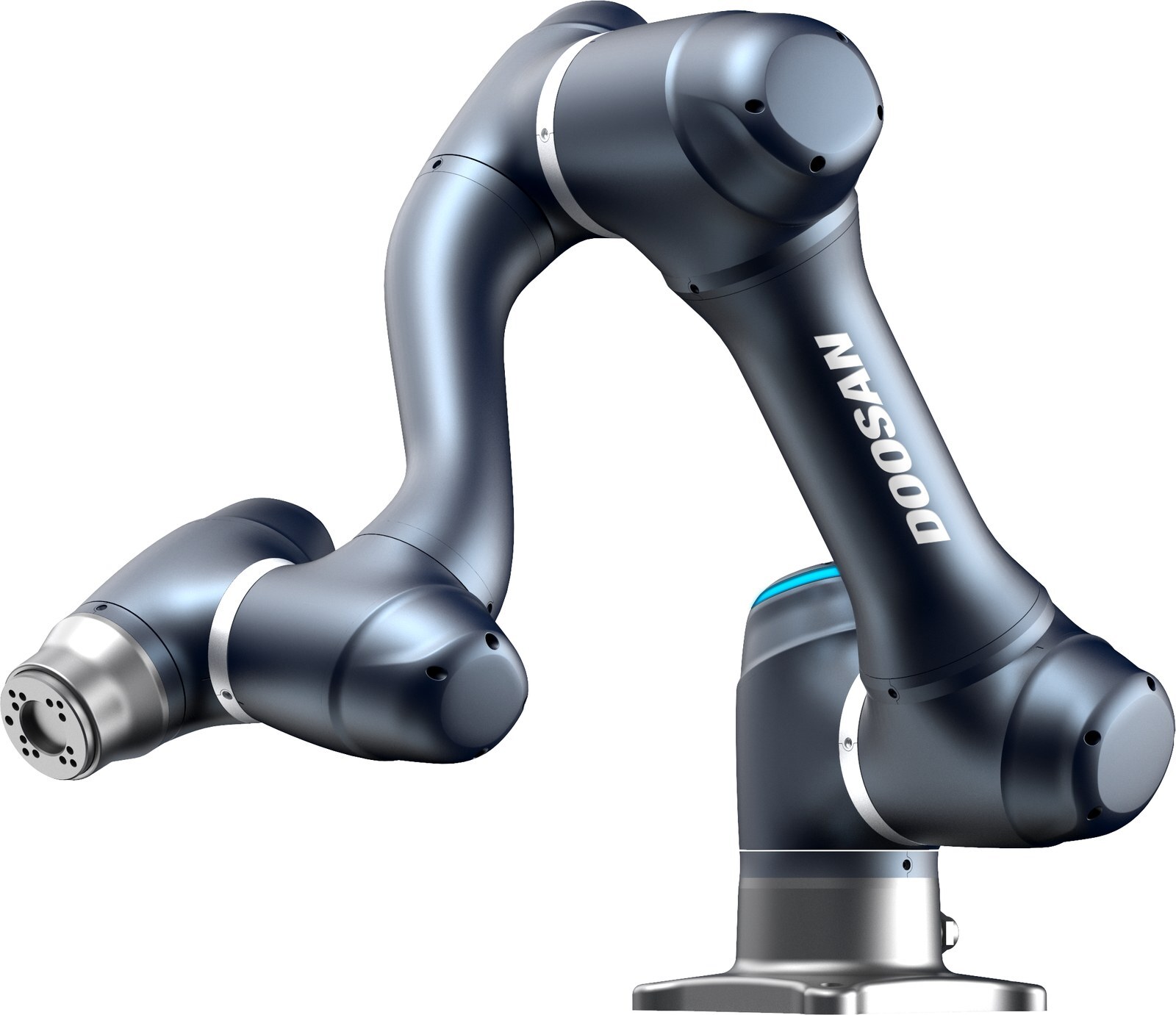
The A-Series targets applications where the part is light and the cycle benefits from a nimble, quick arm. Doosan lists the core applications as pick-and-place, inspection, air blowing, and gluing and bonding—a profile that maps cleanly onto benchtop assembly, quality stations, light material handling, and dispensing work.
Two characteristics define the series. First, low arm mass: at 21 kg for the A0509, it's the lightest arm in the entire Doosan lineup, which makes it genuinely practical to unbolt and relocate between cells rather than treating it as fixed infrastructure. Second, any-orientation mounting—floor, wall, ceiling, or angled—so you can position the arm to suit the cell geometry instead of forcing the cell to accommodate the robot.
The Two Models
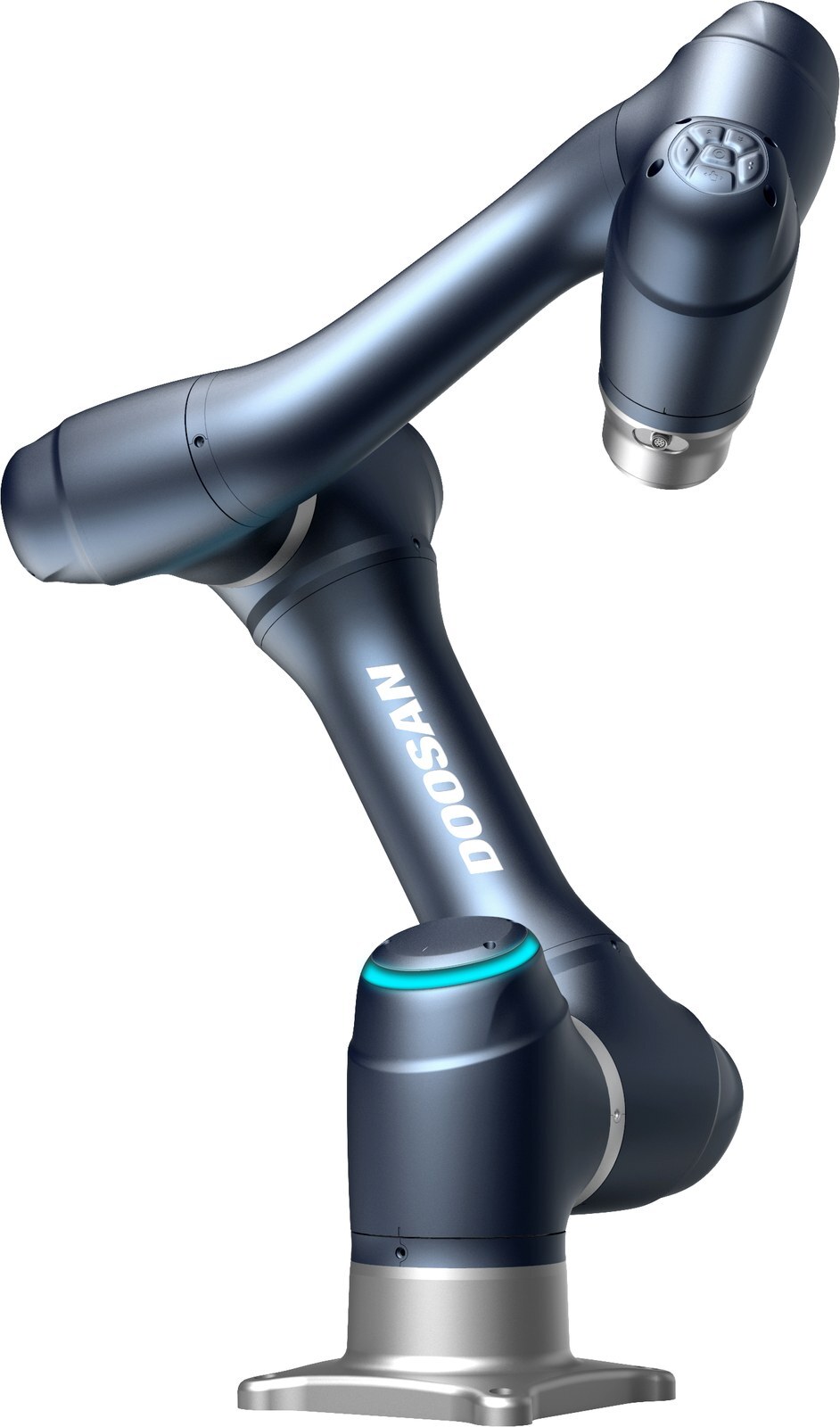
- A0509 — 5 kg payload, 900 mm reach, 21 kg arm weight, ±0.03 mm repeatability, 370 W
- A0912 — 9 kg payload, 1,200 mm reach, 31 kg arm weight, ±0.05 mm repeatability, 440 W
The split between them is straightforward. The A0509 is the lighter, tighter-precision option: a 5 kg payload in a 900 mm reach with ±0.03 mm repeatability, ideal for compact, accuracy-sensitive tasks like inspection routines and fine pick-and-place. The A0912 trades a little agility for reach and capacity—9 kg payload, 1,200 mm reach—stepping up to larger parts and wider work envelopes while still sitting firmly in the "light and fast" category. Its repeatability eases slightly to ±0.05 mm, which is still tight for the kind of work it's aimed at.
Both arms share the joint motion profile that gives the series its name. The wrist joints (J4–J6) move at up to 360°/s, and the base joints (J1, J2) at up to 180°/s, with J1, J2, J4, J5, and J6 all offering ±360° of rotation—generous range that helps the arm reach awkward approach angles without repositioning the workpiece.
Where the A-Series Fits
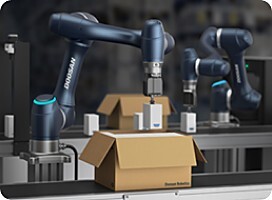
A few application patterns where the A-Series tends to be the right call:
- First cobot deployments and pilots. When a team is proving out collaborative automation, the A-Series lowers the stakes: light enough to move, simple to mount, and inexpensive in capability terms relative to the heavy arms. You learn the platform on a forgiving model.
- Inspection and quality stations. The tight repeatability and quick wrist speeds suit camera positioning, measurement routines, and repetitive check sequences where the arm isn't lifting much but needs to hit the same pose reliably.
- Light pick-and-place. Loading small components into fixtures, transferring parts between conveyors, or kitting—anywhere the part is under 5–9 kg and throughput matters.
- Dispensing and finishing. Gluing, bonding, and air-blow-off are all listed applications; the smooth high-speed wrist motion and force sensitivity help with consistent bead-laying and controlled contact.
Implementation Notes
The A-Series carries the full Doosan platform underneath it, so implementation looks the same as any other model in the family—which is the point of standardizing on Doosan in the first place.
On connectivity, the A-Series supports EtherNet/IP, PROFINET, Modbus TCP, Modbus RTU, TCP/IP, and serial RS-232/RS-422/RS-485, so the arm drops into whatever PLC and fieldbus environment your line already runs. For programming, you get DART-Suite's drag-and-drop app interface and the two-handed Teach Cockpit for guided teaching, plus open-source language support including Python for teams that want to script more involved logic.
On safety, the A-Series carries the same PL e, Category 4 functional safety certification as the rest of the lineup, with six joint torque sensors giving force sensitivity down to 0.2 N and a configurable collaborative zone that a safety scanner can use to drop the arm into reduced-speed mode when a person enters the space. As always, the collaborative rating still requires a proper application-level risk assessment—the end-of-arm tooling and the workpiece, not just the robot, determine whether a given task can run without guarding.
A couple of practical points to plan around: the A-Series is rated IP54, suitable for typical indoor manufacturing environments but not washdown or heavy particulate exposure, with an operating range of 0–45 °C. And while the any-orientation mounting is a real advantage, remember that mounting angle interacts with effective payload and reach in your specific cell—worth confirming against the work envelope during layout.
The Bottom Line
The A-Series is the agile, lightweight entry point to the Doosan lineup: fast, precise, easy to mount and move, and ideal for pick-and-place, inspection, dispensing, and other sub-10 kg work. If your application leans heavier or needs a longer reach, the M-Series workhorse or H-Series heavy-payload arms are the next step up—and because they share the A-Series' control architecture, safety rating, and connectivity, anything you learn integrating an A-Series arm carries straight over.
If you're weighing the A0509 against the A0912—or trying to decide whether the A-Series is enough for your application or whether you should size up—the HESCO team can help you work through payload, reach, mounting, and integration for your specific cell. Reach out and let's work through it together.
Topics:
.png?width=1200&height=630&name=doosan-p3020-featured-image%20(1).png)
.png?width=1200&height=630&name=doosan-h-series-featured-image%20(1).png)