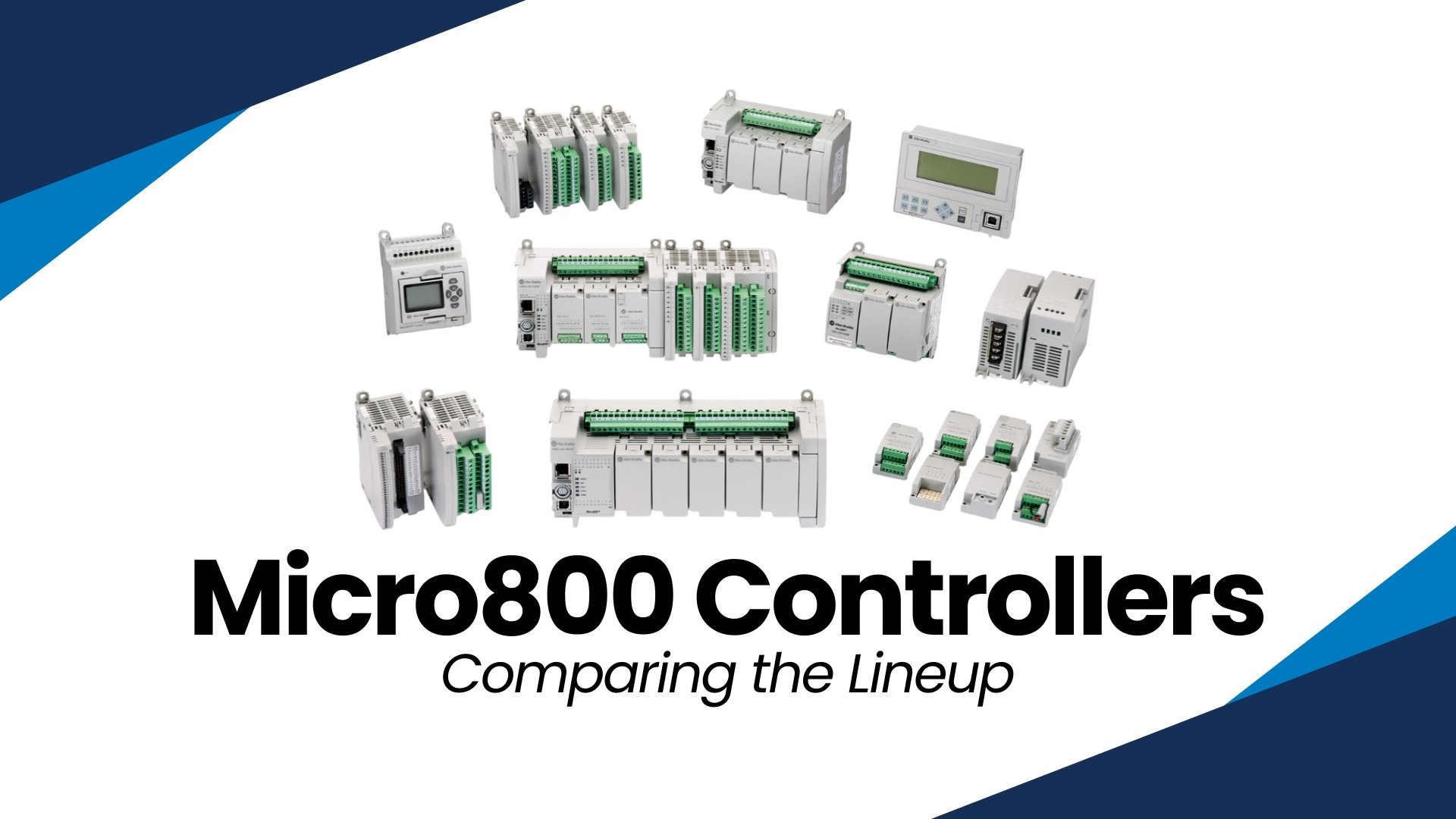
Specifying a PLC for a new machine build means committing to a platform before the full scope of the application is always clear. Choose too conservatively and you'll be working around I/O limitations or missing communication capabilities you need six months in. Choose too aggressively and you've added cost and complexity that the application never justified. The Micro800 family is designed to give engineers a clear progression of capability, but only if you know what actually separates each tier.
At HESCO, we help engineers spec Allen-Bradley controllers across a wide range of standalone machine applications. This article gives you a detailed breakdown of each Micro800 controller—the Micro810, Micro820, Micro850, and Micro870—covering I/O capacity, communication options, motion capability, software requirements, and the application types each one is built for. If you're early in the design process and need to land on the right platform, this reference is made for you.
The short version: the Micro810 is a smart relay for simple logic applications with no Ethernet requirement. The Micro820 adds Ethernet, remote automation capability, and analog I/O in a compact form. The Micro850 steps up to full expansion I/O, motion control, and EtherNet/IP for larger standalone machines. The Micro870 is the top of the family; the maximum I/O, maximum memory, DNP3 support, and legacy PCCC communication for the most demanding standalone applications.
Micro810: Smart relay with PLC programming capability
The Micro810 occupies a unique position in the Micro800 family. It's priced and sized like a smart relay but programmed like a PLC, which makes it a legitimate option for applications that need more than a standard relay but don't require the overhead of a full controller platform.
The hardware is a fixed 12-point configuration—eight inputs and four outputs with no expansion capability. Input models are available in 12/24V DC and 120/240V AC versions. Outputs run as high-current 8A relays on relay output models, which eliminates the need for external relays in most lighting, heating, and compressor control applications. Four of the input channels can be configured as 0–10V analog inputs, giving the Micro810 basic analog sensing without additional hardware.
The Micro810 includes an optional 1.5-inch LCD display that mounts directly to the front of the controller and can be removed under power. The display runs a built-in menu for controller configuration, I/O monitoring, and mode switching without needing a connected PC. This matters for applications where ongoing access to a laptop isn't practical.
Programming is done through Connected Components Workbench via a USB port (adapter required), using the same instruction set as the rest of the Micro800 family. The Micro810 supports up to four smart relay function blocks (Delay ON/OFF Timer, Time of Day, Time of Week, Time of Year, and Counter) that can be configured directly from the LCD without downloading a program. This makes it genuinely useful for simple scheduling and timing applications where a full program isn't necessary.
What the Micro810 doesn't have: Ethernet, serial communication, plug-in modules, expansion I/O, or motion capability. If your application needs any of those, start at the Micro820.
Typical applications include lighting control, HVAC scheduling, compressor sequencing, elevator control, simple timing logic. Check it out on our webstore here.
Micro820: Ethernet-enabled remote automation
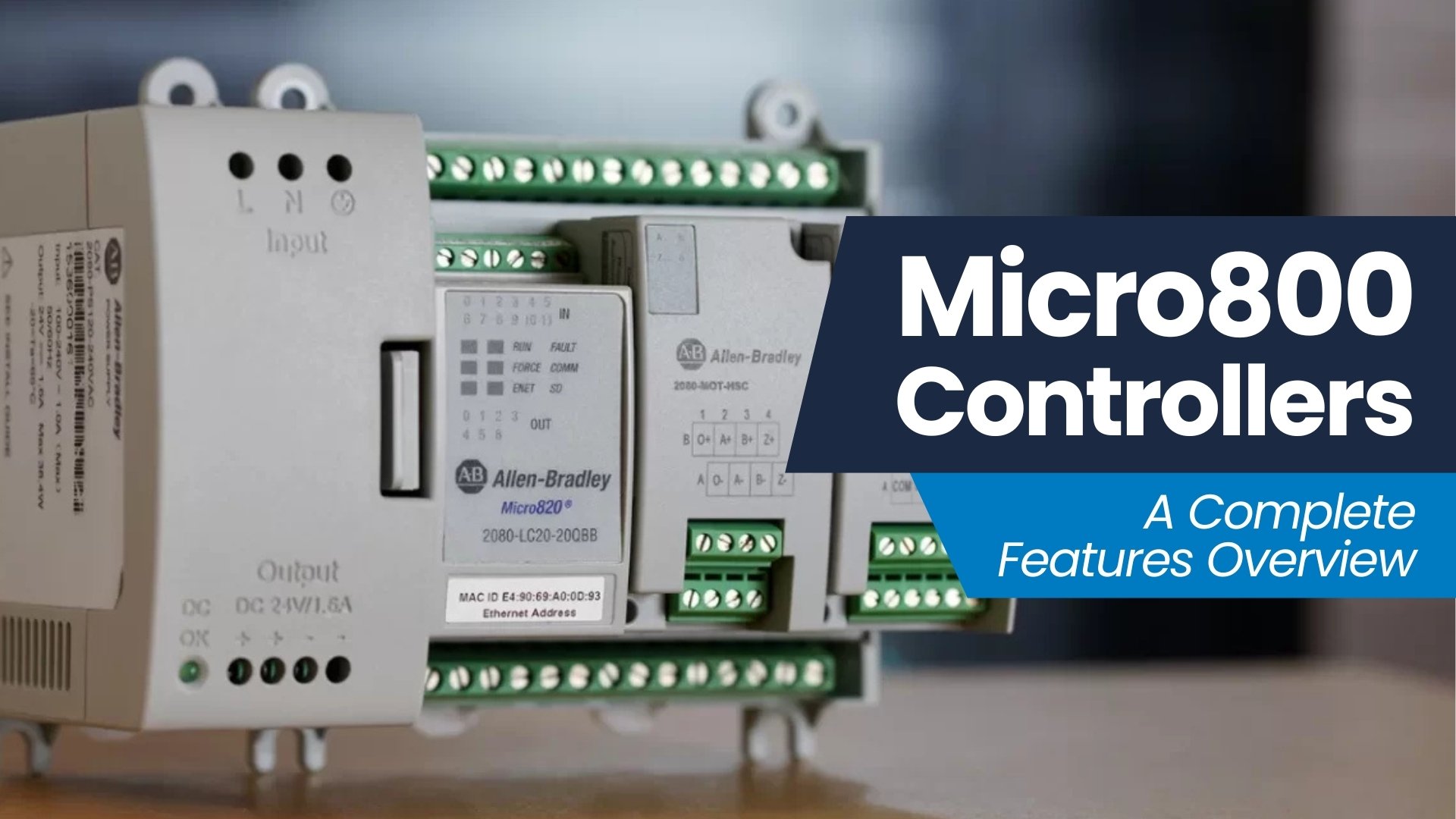
The Micro820 is where the Micro800 family becomes a real networked controller. It's a 20-point base unit available in multiple I/O configurations, with embedded Ethernet, a serial port, and enough analog capability built in to handle a significant range of applications without any plug-ins.
The embedded I/O includes four analog inputs and one 0–10V analog output, which covers speed and torque reference for variable speed drives directly from the base unit. The Micro820 also supports up to four 10K thermistor temperature inputs, making it a direct-digital-control option for building management systems—a use case where most PLCs require additional modules. A built-in real-time clock with no battery required rounds out the onboard feature set.
Communication on the Micro820 covers EtherNet/IP and Modbus TCP over the embedded Ethernet port, plus CIP Serial, Modbus RTU, and ASCII over the RS-232/485 serial port. The Micro820 can function as a remote terminal unit (RTU) for SCADA applications, which makes it a strong fit for remote pump stations, water treatment sites, and any application where the controller needs to report back to a central system over a network.
The newer Micro820 L20E variant adds USB Type C connectivity for faster configuration and program download and supports Class 1 implicit messaging for up to four EtherNet/IP nodes, including pre-defined tag support for PowerFlex 520 series and Kinetix 5100 drives. This is a meaningful upgrade for applications that need tight drive integration without the overhead of explicit messaging.
The Micro820 supports up to two plug-in modules, a microSD card slot for program transfer, datalog, and recipe management, and an optional remote 3.5-inch LCD display that connects via the RS-232 port. It does not support expansion I/O modules or motion via pulse train output; for those capabilities, you need to move to the Micro850.
Typical applications include remote water pump management, car wash systems, stretch wrappers, building direct digital control, SCADA RTU applications. Check it out on our webstore here.
Micro850: Larger standalone machines with motion and expansion I/O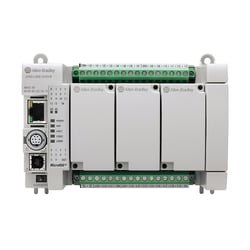
The Micro850 is the workhorse of the Micro800 family. It's built for standalone machines that need real I/O density, Ethernet connectivity, motion control, and the flexibility to expand as the application grows. If you're specifying a controller for a packaging line, labeler, or any machine with more than a handful of I/O points and a drive or two to control, the Micro850 is usually where the conversation starts.
The base unit comes in 24-point and 48-point configurations with embedded 24V DC power supply. Up to five plug-in modules extend the base functionality without increasing footprint, and up to four Micro800 expansion I/O modules (Bulletin 2085) snap onto the right side of the controller to bring the total digital I/O count to 192 points. Expansion modules support 14-bit analog input resolution and 0.1% accuracy—significantly better than the plug-in analog modules—along with isolated analog inputs and configurable filter times for precision process control.
Motion capability on the Micro850 runs up to three axes via pulse train output (PTO) using PLCopen-compliant motion instructions. Combined with the embedded high-speed counter inputs (100 kHz on 24V DC models), the Micro850 handles most component motion applications like labelers, cutters, and positioning systems without requiring a dedicated motion controller.
The Micro850 L50E adds Class 1 implicit messaging for up to eight EtherNet/IP nodes, expanded DF1 support including full-duplex master, half-duplex slave, and radio modem modes, and PCCC support (firmware revision 23.011 or later) for communication with legacy MicroLogix controllers and SCADA systems. Remote LCD display support was added in firmware revision 23, which helps teams modernizing from MicroLogix 1100 and 1400 hardware maintain familiar operator interface functionality.
Typical applications include adhesive labelers, cartoners, solar panel positioning, sleeving machines, intermittent form-fill-seal equipment, stretch wrappers. Check it out on our webstore here.
Micro870: Maximum I/O, memory, and protocol support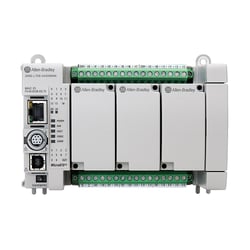
The Micro870 is the top of the Micro800 family and the right choice when the application pushes past what the Micro850 can handle, either in I/O count, memory, or communication requirements. It scales the Micro800 platform up to CompactLogix 5370 L1 territory while keeping the same programming environment and module ecosystem.
The Micro870 supports up to eight expansion I/O modules and 304 digital I/O points, compared to the Micro850's four modules and 192 points. Program and data memory are doubled relative to the Micro850—up to 20,000 programming steps and 280 KB—which matters for machine builders who want to maintain a single large program across multiple machine models and configurations without constant memory optimization.
Motion on the Micro870 runs up to two axes via PTO, supported by four 100 kHz high-speed counter inputs and PLCopen motion instructions. The slight reduction in axis count relative to the Micro850's three axes is worth noting for motion-heavy applications, though the Micro870's additional memory and I/O capacity typically make it the better overall fit for complex machines.
The Micro870's standout communication feature is DNP3 support, available on the 2080-L70E-xxxxN catalog variants. DNP3 with Secure Authentication version 2 and version 5 is supported over both serial and Ethernet, making the Micro870 the only Micro800 controller suited for utility, water/wastewater, and energy infrastructure applications where DNP3 is a hard requirement. PCCC support (firmware revision 22.011 or later) enables legacy MicroLogix address mapping and native read/write instructions for modernization projects where the SCADA or HMI system isn't being replaced.
An expansion power supply module (catalog 2085-EP24VDC) is required when configuring more than four expansion I/O modules. It’s worth accounting for this in your panel design early.
Typical applications include multi-track VFFS machines, large standalone curing equipment, semiconductor gas cabinets, pipe heating systems, blown film extrusion, large heat exchange systems, large welding machines. Check it out on our webstore here.
A Final Comparison
The Micro800 family covers a wide range of standalone machine applications, but each tier is genuinely distinct. The Micro810 is for simple logic with no network requirement. The Micro820 is for networked remote automation. The Micro850 is for larger machines that need expansion I/O and motion. The Micro870 is for the most demanding applications where memory, I/O count, or DNP3 communication are non-negotiable.
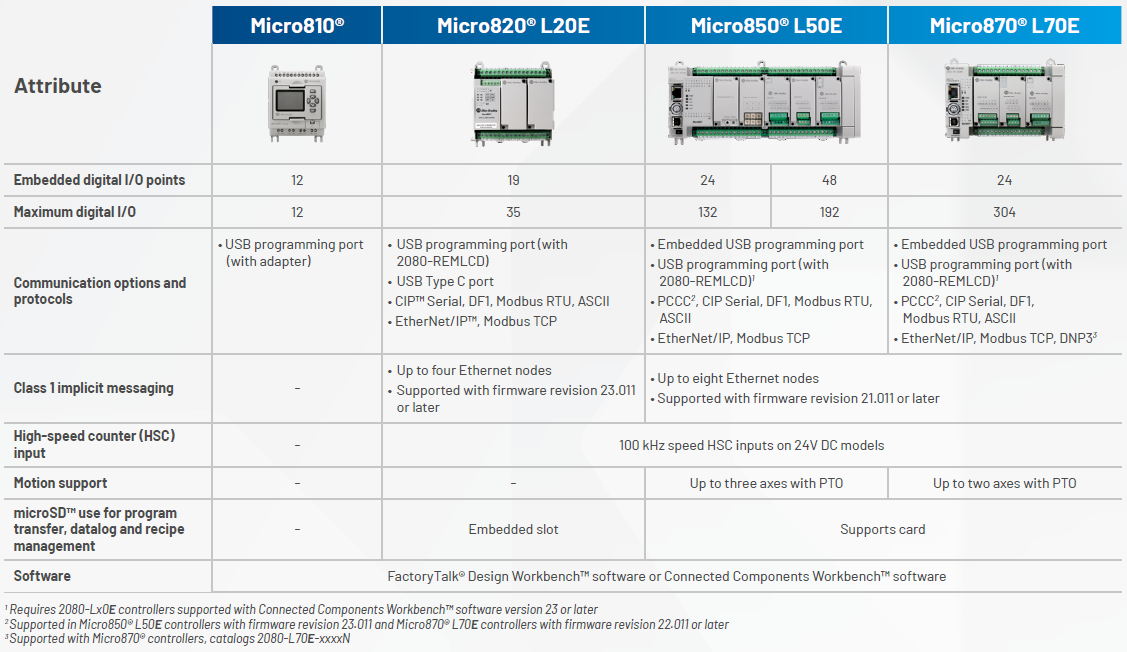
If you're in the middle of a machine spec and want to talk through which controller fits your application, the HESCO team is here to help. Contact us today and we'll get you to the right platform before it becomes a problem to unwind.