
When a technician pulls the wrong conductor during a service call or can't trace a circuit because the labels have faded or fallen off six months after installation, the downstream costs add up fast: rework, delays, safety incidents, and failed audits. Labeling gets treated as an afterthought on too many jobs, which means teams are either borrowing a printer from another crew, handwriting tags in the field, or skipping identification entirely and hoping the as-builts are accurate.
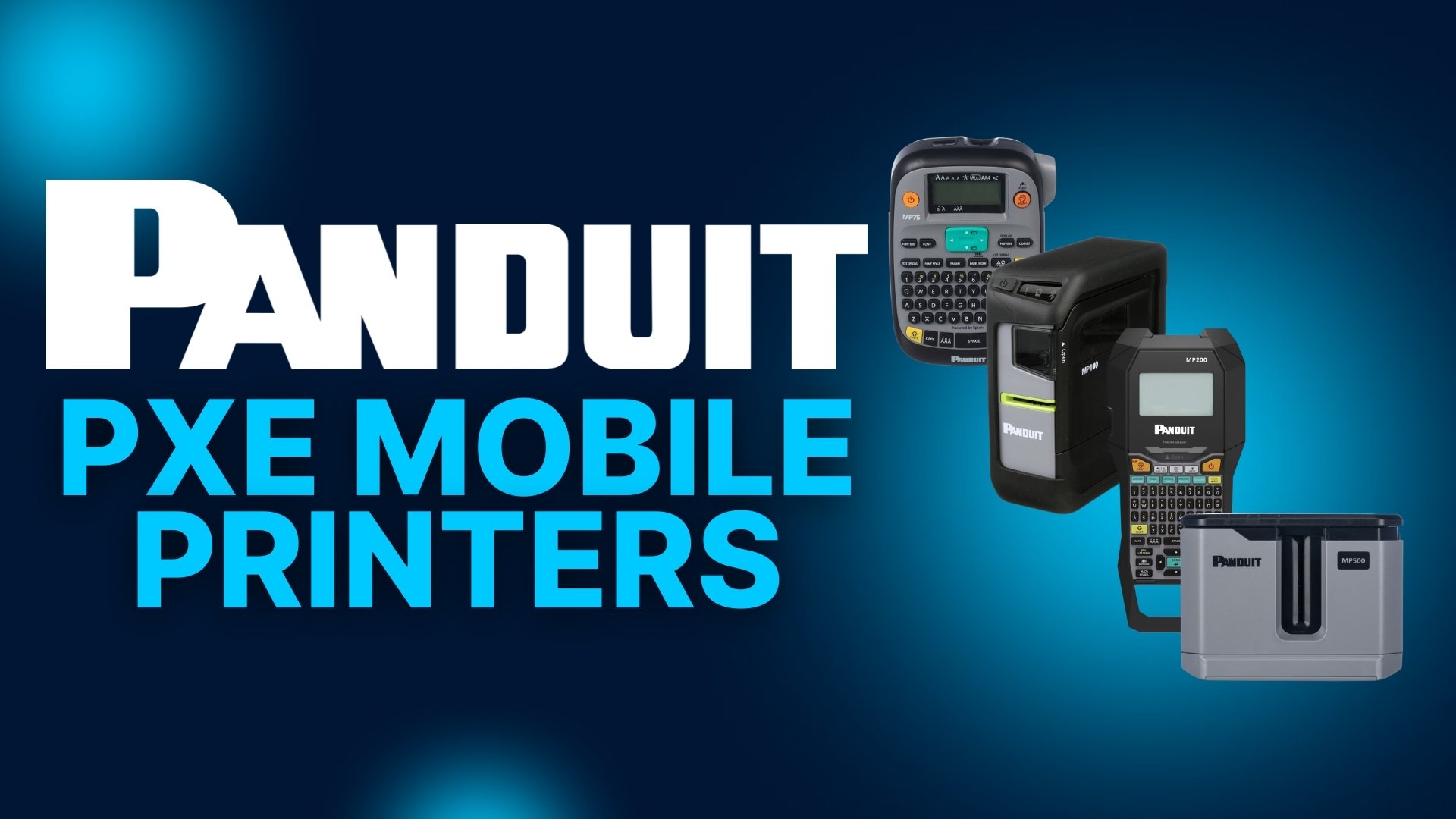
Panduit's PXE Mobile Printer line is designed to fix that problem—but with six models at different price points, label type compatibility varies significantly across the lineup. Choosing the wrong model means either overpaying for features you won't use or capping your label options in ways that don't become obvious until you're already on the job. HESCO carries the full PXE line along with all available replacement cartridges. This guide breaks down the PXE lineup by use case, so you can match the right printer to the work you're actually doing.
Here's the short version: the MP75 and MP100 are solid entry-level options for basic wire and cable ID; the MP200 and MP300 are the mid-tier workhorses with better speed, resolution, and label compatibility; and the MP500 and MP550 are built for high-volume production work where throughput and label variety matter most. The Panduit–Epson partnership behind this line means print quality and hardware reliability are consistent across the board—the main differences between the models come down to capability and application fit.
The Lineup at a Glance
Entry Level: MP75 and MP100
These two models cover the basics for contractors and technicians who need a portable label printer without a major capital investment. They're compact, lightweight, and capable of handling the most common wire and cable ID tasks on smaller jobs.
MP75: The Pocket-Sized Option
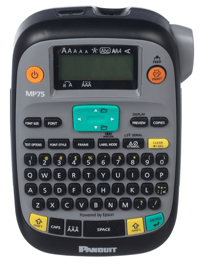 At 0.9 lbs. and less than 7 inches long, the MP75 is the most portable unit in the lineup. It has a QWERTY keyboard, backlit LCD screen, and a built-in barcode and symbol library, which means it operates as a standalone device without needing a laptop or software connection.
- Maximum label width of 0.75 in., suitable for standard wire ID but not larger cable or panel applications.
- Print speed of 0.25 in./sec., adequate for low-volume tasks—but if you're knocking out a large termination schedule, this will be your bottleneck.
- Compatible with continuous vinyl and polyester tapes, heat shrink, non-laminated labels, and marker plates. This covers the essentials, though die-cut self-laminating and Turn-Tell labels are not supported.
MP100: Step Up in Speed and Label Support
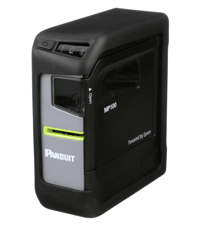 The MP100 bumps print speed to 0.6 in./sec. and adds PC interface capability for use with Panduit's Easy-Mark labeling software. It ships with a protective impact bumper, which matters in environments where gear gets set down hard.
- Supports 1.0 in. maximum label width, opening up more label options versus the MP75, including a broader range of self-laminating wire labels.
- Easy-Mark software compatibility means you can design and batch-print label runs from a laptop—useful when you're pre-staging labels before hitting the field.
- No wireless capability at this tier; you're wired via USB, so account for that if mobility is a priority.
Mid-Tier Workhorses: MP200 and MP300
This is where most commercial and industrial users will land. The MP200 and MP300 offer a meaningful jump in print speed, resolution, and label compatibility without crossing into the higher cost and weight of the production-grade models.
MP200: Speed and Versatility for Field Work
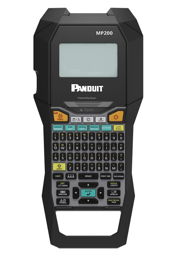 The MP200 is available as a standalone unit or as the MP200-KIT, which adds a hard carrying case, rechargeable battery pack, magnetic feet, and power adapter. The KIT configuration is worth the premium if the printer is going into rotation across a crew. Find it on our webstore here.
- Print speed of 1.2 in./sec., roughly double the MP100 and enough to handle moderate label volumes efficiently during termination work.
- Supports die-cut self-laminating labels and Turn-Tell labels, expanding what you can label and how. The entry-level models don't cover these label types.
- Magnetic feet included in the KIT version let the unit attach to panels or enclosures hands-free, a small feature with real practical value in tight spaces.
MP300: Higher Resolution and Wireless Printing
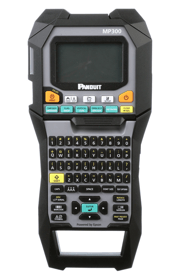 The MP300 is the top performer in the handheld category. It adds 360 dpi print resolution (double the MP200's 180 dpi) and wireless print capability, including a mobile app for on-device label design. For jobs that require crisp barcode printing or fine-text labels, the resolution difference is noticeable. Find it on our webstore here.
- 1.5 in. maximum label width—the widest in the handheld tier, supporting larger wire and cable ID labels, including labels for Cat 6A FTP and 8–4 AWG conductors.
- Wireless and mobile app printing, which comes in handy when working in areas where running a USB cable to a laptop isn't practical, or when printing labels on demand from a tablet during inspection.
- Ships with a hard carrying case and magnetic attachments. The MP300 is built to travel, and the included accessories reflect that.
Production Grade: MP500 and MP550
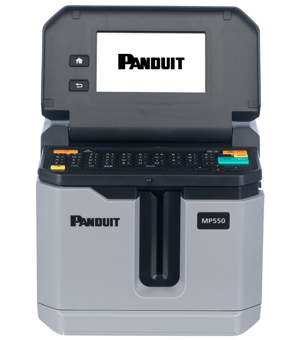
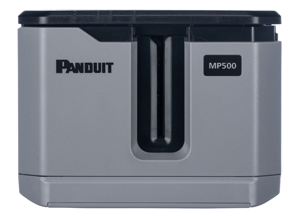
The MP500 and MP550 are in a different category from the rest of the lineup. These are benchtop or cart-mounted units designed for high-volume label production. At 6–7 lbs., they're not field-portable in the same sense as the smaller models, but they print at 2.0 in./sec. and support the widest label stock in the PXE system at 2.0 in. maximum width.
- Automatic cutter with half-cut and full-cut capability, plus replaceable cutter blades. When you're printing hundreds of labels in a session, an automatic cutter stops being a convenience and starts being a productivity requirement.
- Compatible with an attachable rewinder (MP-REWINDER) for bulk label jobs—this is the configuration for pre-staging large label runs in the shop before deployment.
- The MP550 adds a rechargeable Li-Ion battery pack that the MP500 lacks. If you need the production capacity of this tier but want battery operation, the MP550 is your unit.
- Supports the full range of PXE label types: every cassette format in the catalog is compatible, giving shops maximum flexibility as job requirements change.
The Label Ecosystem: Why It Matters as Much as the Printer
The printer is only half the decision. The PXE system's real depth is in its label library, and your application should drive your selection as much as the printer hardware does. Key label types to know:
- Die-Cut Self-Laminating Labels (VAM): The standard for wire and cable ID. The white print-on area is protected by a clear overlaminate, rated from -40°F to 150°F. Available from MP200 and up.
- Heat Shrink Labels (H1M/H2M): Non-adhesive polyolefin tubing that shrinks over the conductor after printing; 3:1 shrink ratio, rated down to -67°F and up to 275°F. Meets SAE-AS5942 and MIL-STD specs for applications where those matter.
- Turn-Tell Labels (V1M): Designed to rotate on the wire for 360° visibility and can be installed on terminated wires without disconnecting. A practical choice for dense panel environments.
- Network Component Labels: Die-cut labels sized for patch panels, faceplates, and punchdown blocks. Formatted for 1-port through 6-port identification, with polyolefin and non-adhesive polyester options.
- Continuous Tape Cassettes: Available in vinyl, polyester, and magnetic materials across a range of colors, including safety colors (blue, green, orange, red). Used for pipe markers, voltage markers, bin labels, and custom signage.
The Bottom Line
The PXE line covers a wide range of labeling needs, and the right model depends on your volume, your label types, and whether you're working in the field or pre-staging in the shop.
Don't let price alone drive the decision, as a mismatch between your printer and the label types your jobs require will cost you more in the long run than upgrading upfront. The MP300 is the most capable handheld unit for most professional applications; the MP500/MP550 are the answer when throughput is the priority.
The HESCO team can help you match the right PXE printer and label configuration to your specific application. Contact your HESCO rep today or visit hesconet.com to request a quote, or explore Panduit’s range of PXE printers for yourself here.
Topics:
